A Lego 9V train gets its power from the track. The rails carry metal strips, a speed regulator plugged into a transformer feeds up to 9 volts of direct current into them, and the motor picks it up through its metal wheels, so a 9V train keeps running for as long as the transformer is plugged in.
Lego introduced the system in 1991 and replaced it in 2006 with RC trains on plastic track, powered by batteries; the last 9V parts left the range in 2007. Nothing is made new any more, so every rail and motor comes from the used market. This guide covers the questions that follow from that: how the track fits together, which trains run on it, what to check before you buy and when converting to batteries makes more sense. We have not taken any measurements for it. Technical details come from Lego's catalogue data and from specialist sources on track geometry.
How the 9V system works
There are three links in the chain. A power adapter turns mains voltage into low-voltage alternating current. The speed regulator converts that to direct current and controls it with a large yellow dial: in the middle the train stops, one way it runs forwards and the other way backwards, because past the centre position the regulator reverses the polarity. One cable takes the power to any piece of track, and from there the whole loop is live.
Lego sold the adapter, regulator and cable together as set 4548, with a power adapter for each country. The regulator itself is part 2868b.
The motor is a complete bogie with metal wheels, buffers and magnetic couplings. Lego sold it from 1991 as set 5300 and reissued it in 2002 as set 10153; both contain the same motor. Contact plates on top of the unit let you power lights inside the train.
Two consequences of this design are worth knowing before you buy. Every locomotive on a powered loop gets the same voltage, so they all start together, run in the same direction and at a similar speed. Running two trains independently takes separate loops and two regulators. A reversing loop does not work out of the box either: when the track curves back on itself, the left rail meets the right rail and positive meets negative, which is a short circuit. Only the battery-powered RC trains of 2006 made reversing loops and several independent trains easy.
The big advantage shows in use. In our experience, 9V is the system you can leave running round the Christmas tree all afternoon without swapping a single battery. The cost is wear: a motor that runs for days on end wears out, and replacements only come second-hand. We would not plan on a 9V locomotive for weeks of continuous running.
Lego train systems at a glance
| System | Years | Power | Track |
|---|---|---|---|
| 4.5 volt | from 1966 | Battery box in the train or in your hand | Not powered, blue at first |
| 12 volt | 1969 to 1991 | Transformer, power through a two-pole centre rail | Grey, separate rail profiles on sleepers |
| 9 volt | 1991 to 2007 | Transformer and speed regulator, power through metal strips on the running rails | Metal-topped, dark grey sleepers, dark bluish grey from 2003 |
| RC | from 2006 | Batteries in the train, infrared remote | Plastic |
| Power Functions | from 2009, now retired | Batteries, infrared | Plastic |
| Powered Up | since 2018 | Batteries in the hub, Bluetooth | Plastic |
Track geometry: straights, curves, points and crossings
Lego has never changed the track gauge, and the 9V curve radius is the same as on today's plastic track. When you plan a layout, work in studs. One stud is 8 mm wide.
| Track piece | Part number | Size |
|---|---|---|
| Straight | 2865 | 16 studs long (12.8 cm); eight make about 1 m |
| Curve | 2867 | 40-stud radius (32 cm) to the track centre; 16 curves make a circle |
| Left / right points | 2861 / 2859 | 32 studs long, 22.5-degree diverging route, same geometry as the later plastic switches |
| Crossing | 32087 | 90 degrees, 16 × 16 studs |
A circle of 16 curves measures about 88 studs across the outside of the sleepers, or roughly 70 cm (27.7 in). Long wagons swing outwards on the curve, so leave more room than that on the table. Sets that sold the track include 4515 with eight straights, 4520 with eight curves and 4531 with a pair of points.
The points have one quirk. A 9V point plus a curve in the other direction gives a parallel track 16 studs from the main line, centre to centre, with an 8-stud gap between them. On the older 4.5V and 12V points the siding ran right alongside the main line. The extra space means fewer collisions, but the point and the curve that follows form an S-bend, which long trains can struggle with. Run a long train slowly through each point before you fix the layout in place.
Lego only ever made this one radius for standard trains, so wider curves come from third-party makers. In our experience R40 works for most Lego trains, but a wide curve like R104 is nicer, especially with long carriages. On 9V you need metal-topped rails for that, which we come to below.
Compatibility with Powered Up, Power Functions, 12V and 4.5V
Gauge and geometry have stayed the same, so 9V track and today's plastic track clip together. Whether a train runs on them depends on where it gets its power.
| Train | On 9V metal track | On plastic track (RC, Power Functions, Powered Up) |
|---|---|---|
| 9V locomotive | Yes, power from the rails | No, the motor gets no power |
| Powered Up or Power Functions train | Yes, on its own batteries | Yes |
| Old 4.5V battery train | Yes | Yes, the gauge is the same |
| 12V locomotive | No, it needs the centre rail | No |
| Unpowered wagons | Yes | Yes |
A mixed layout works if each train has its place: 9V locomotives stay on the metal loop, battery trains go anywhere. A 9V locomotive that rolls onto a plastic section stops there. Older plastic track with four-digit set numbers, such as 7499 (flexible and straight tracks), also works with today's trains.
The grey 12V track is built differently. Rails and sleepers are separate parts, and the joints do not clip onto 9V or plastic track without modification. A 12V locomotive only runs on 9V track if you swap its motor for a 9V one.
Buying 9V used: what to check
Lego stopped making 9V almost two decades ago, and the used market is mixed. A complete bundle of track, regulator and working motor is worth more than a box of rails. Check the three parts separately.
Track: Look at the metal strips. A yellowish-brown haze is tarnish; brown-black spots with a rough surface are rust. Both insulate and can make a train stutter in places. Light tarnish comes off, deep rust pitting usually does not. Also look for bent strips and broken connectors. If looks matter to you, ask about the colour: the sleepers were dark grey until 2003 and dark bluish grey after that, and the difference shows on a mixed layout.
Motor: Ask to see the motor run on track, in both directions, slow and fast. It should pull away smoothly and run through a curve without jerking. Loud grinding, or a motor that only starts at full power, are warning signs. Since every motor is second-hand, this is where to look closest.
Transformer and regulator: The power adapter has to match your mains supply. Lego shipped 4548 with country-specific adapters, including a 120-volt version for North America and 240-volt versions for the UK and Australia. A North American adapter does not belong in a 230 or 240-volt socket, travel plug or not, and a European or UK adapter will not deliver the right voltage on 120 volts. On the regulator, the yellow dial should click cleanly into place and the train should run both ways.
Prices follow a clear pattern: straights cost more than curves. In our catalogue, the current market price for eight straights (4515) is about three times that of eight curves (4520). A single 9V motor (10153) costs several times as much as a new Powered Up train motor. Check the price history there and for the transformer and speed regulator 4548 before you buy a bundle.
Cleaning and caring for metal rails
Power flows at the inside edge of the rail, where the wheel flange touches it. The wheels rub that edge clean as they run, so track often looks cleaner than it is. After long storage, always clean the rails before the first run.
For ordinary dust, a lint-free wipe with 99% isopropyl alcohol is enough; 70% alcohol contains too much water. Metal polish or non-gel toothpaste on a cotton bud deals with tarnish, followed by a wipe with isopropyl. Keep acetone and other ketone-based solvents away from Lego track, because they attack the ABS plastic of the sleepers. Store the track somewhere dry afterwards.
Converting a 9V train to batteries
If the 9V motor fails, or you want your train to run on plastic track too, there are two ways to do it.
The simpler one is Powered Up. The 88011 train motor has the same outer dimensions as the 9V motor and usually fits in the same spot under the locomotive. Add the 88009 hub for the batteries and the 88010 remote or the Powered Up app. The hub has to go inside the locomotive or a wagon, and on slim 9V models that is the real work of the conversion.
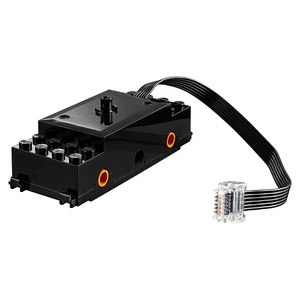
- Pieces: 7
- Age: 7 and up
- Same outer size as the 9V motor
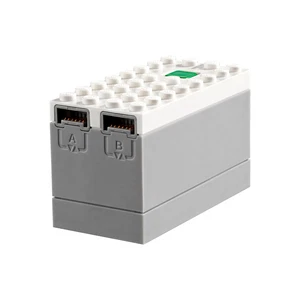
- Pieces: 1
- Age: 7 and up
- Two ports, batteries not included
After the conversion, the train runs on any track, including your old 9V rails. It now needs batteries, though, and with several trains, swapping or charging them becomes routine. Our comparison of Lego 88009 and BuWizz covers whether a third-party hub suits you better, and our overview of Lego motors and alternatives explains all the motor systems.
The second way keeps the 9V motor. Its contact plates connect to a Power Functions battery box through a Power Functions 8886 extension cable, and then it runs on plastic track too. Power Functions is retired as well. Without an infrared receiver you switch the train on the battery box itself; for a remote you need the receiver too. This route mostly makes sense if you already own the parts.
Third-party metal rails
Only a few makers produce new powered track. We have not tested any of these products; the details come from the makers.
Fx Track by Fx Bricks currently sells metal-railed track. The rails are nickel-plated copper-beryllium alloy and the sleepers are ABS. Fx Bricks says the track is compatible with Lego 9V and RC track. The range has straights from 1.6 to 32 studs, curves from R56 to R152 and a pair of points whose diverging route matches R104. The catalogue lists no R40 curve, so it suits wide curves, while a compact circle still needs Lego's own curves.
ME Models also made metal rails in the past, but they are no longer available.
BrickTracks sells R56, R104 and R120 curves and R104 points, but as of October 2026 no 9V version. TrixBrix makes a wide choice of radii and points, some injection-moulded, some 3D-printed. In our experience the moulded pieces are as good as Lego's, though they are not cheap. Both are plastic track without power pickup, so they suit battery trains.
For points there is a third category: 4DBrix sells point motors that, according to the maker, fit Lego's 9V points as well as the RC and Power Functions switches.
Lego 9V train FAQ
Can Powered Up trains run on 9V track?
Yes. Powered Up trains take their power from the batteries in the hub, not from the rails, so they run on 9V track just as they do on plastic track. A 9V locomotive and a Powered Up train can even share the same loop; you just control them separately.
Do 9V trains run on today's plastic track?
Not with the 9V motor. It needs the metal strips to get power, so although the track clips together, the locomotive stops on a plastic section. With a Powered Up motor or a Power Functions battery box, the train runs there too.
Can I use a different power adapter with the 9V regulator?
The regulator expects low-voltage alternating current, roughly 9 to 12 volts, from an external adapter. The safest choice is the original Lego adapter for your country. If you want to use a third-party adapter, compare its output voltage, current type and plug carefully with the original.
Keep it, extend it or switch?
- You already have a 9V layout that works: Keep it. Clean the track, check the motor and add straights as you need them.
- You want long runs without battery changes, for example round the Christmas tree: 9V is the right system for that, but plan for a replacement motor.
- You want to control several trains independently or build reversing loops: Switch to Powered Up. Your 9V track still works for it.
- You are starting from scratch: Do not buy a 9V bundle just for the system. New Powered Up trains are easier to find and to extend, and our guide to your first Lego train helps you get going. If you are open to other brands, our Lego train alternatives compare brick-built and wooden railways.
Current trains and prices are on our railway page.