
A motor can fit between Technic beams and still be electrically useless with the hub already in your model. That is why we no longer describe products simply as “Lego compatible”. The important questions are whether the pin and axle geometry fits, whether the plug matches, which protocol carries commands, and whether an app or remote actually supports that component.
This overview covers retired Power Functions hardware, the current Powered Up family, Technic Control+, SPIKE and discontinued Mindstorms components. It also explains where third-party motors, battery boxes and complete motorized sets make sense. Availability changes, so the four shopping examples below are localized listings that were checked as purchasable; they are examples, not a claim that one product suits every build.
Four currently buyable motor options
These recommendations preserve different commercial purposes: a broad Power Functions-style kit, a compact rechargeable controller, a complete motorized third-party model and an original Powered Up train motor. Batteries are not assumed to be included unless the listing explicitly says so.
32-piece Power Functions-style kit: broad replacement inventory
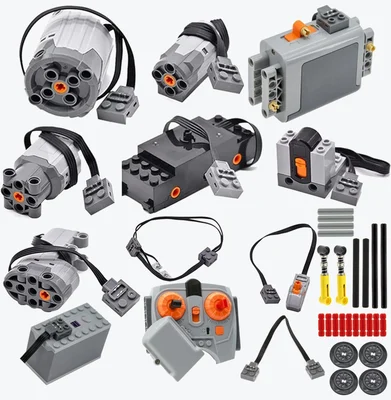
This unbranded 32-piece kit is aimed at builders who need several PF-style functions at once. The listing names M, L, XL, servo and train-style motors alongside AA and AAA battery boxes, an infrared receiver, remote, switch, extension cable and lights. That makes it more useful as a parts inventory than as a single carefully documented ecosystem.
The components use Power Functions-style connections and familiar Technic mounting, not the Powered Up connector or protocol. Treat the included product numbers as form-factor references rather than proof of genuine Lego parts. Check each motor under light load before installing it in a heavy model, and budget for the required batteries.
Mould King M0019 6.0 module: remote and app control
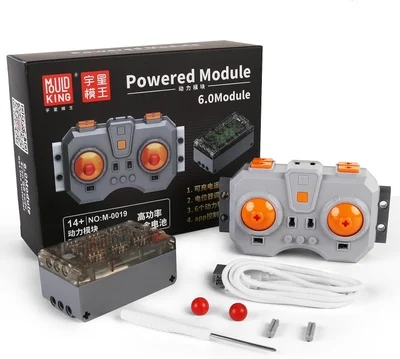
Mould King’s M0019 package combines a 6.0 battery/control module, rechargeable remote, USB charging cable and control pieces. Its appeal is the compact control system: the listing advertises a six-channel 2.4 GHz remote plus app control and programmable functions. It is suitable when the model already has matching Mould King motors or when the whole power chain is being designed together.
It is not a drop-in Powered Up hub. The physical fit of the box within a Technic frame does not establish electrical or app compatibility with Lego motors. Verify the exact connector on the motors you intend to use, install only the supplied charging arrangement and allow ventilation around a battery box enclosed in a dense body.
CaDA C61036W HUMVEE: a complete motorized system
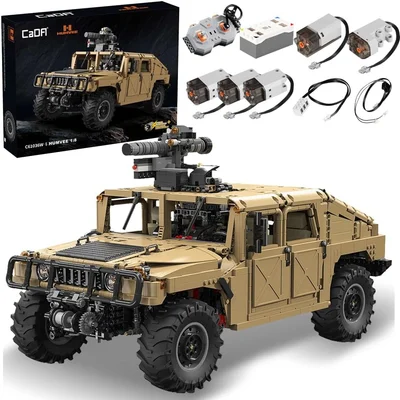
The CaDA C61036W is a complete 3,935-piece, 1:8-scale motorized model rather than a loose motor kit. Its listing describes remote-controlled driving and functions including steering, lights, a winch and powered accessories. Choosing a complete set avoids much of the connector matching because the motors, control unit and structure are sold as one designed system.
This is the option for builders who want a substantial third-party Technic-style project, not for repairing an existing Lego drivetrain. Compatibility claims refer mainly to the construction format; they do not make its electronics part of Powered Up or Control+. The model is large and mechanically complex, so it is better suited to experienced builders who want the supplied functions than to a first experiment with motorization.
Lego Powered Up 88011: the straightforward train motor
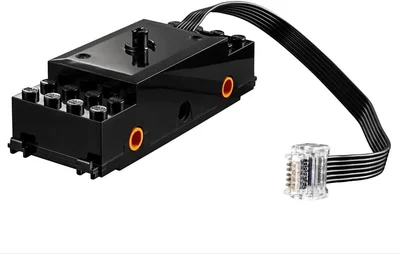
The original Lego 88011 train motor includes two axles, four wheels and a Powered Up cable. It is the least ambiguous choice here for a current-style Lego train. It still needs a compatible Powered Up hub and a supported remote or app; the motor alone does not provide power or wireless control.
Do not confuse 88011 with the retired Power Functions 88002 train motor. Their roles and basic mounting are similar, but their connectors and control chains differ. If a train already has an infrared receiver and PF battery box, replacing only the motor with 88011 will not complete the conversion.
The Lego motor ecosystem in 2026
Power Functions: useful, but retired
Power Functions used the familiar two-part plug, infrared receivers and battery boxes such as 8881 and 88000. M, L, XL, servo and train motors remain common in older Technic models and custom builds, but Lego has retired the range. Original components and third-party replacements can keep an old model running, yet new stock, condition and seller support vary.
Power Functions compatibility must be checked at three levels. A replacement may accept Technic pins and cross axles, copy the electrical plug and still respond differently to a controller. Generic kits also vary in motor direction, speed steps and overload protection. Never connect bare wires, adapters or battery packs solely because the plug can be forced into place.
Powered Up and Control+
Powered Up uses the newer six-wire LPF2-style connector and Bluetooth hubs. The 88011 train motor, 88009 hub, lights and other elements belong to this family. They are not direct electrical replacements for Power Functions. A mechanical redesign is sometimes unnecessary, but an old infrared receiver cannot command a Powered Up motor without replacing the control chain.
Control+ is the Technic-focused experience built around Powered Up hardware. The Technic hub has four input/output ports, an integrated tilt sensor and Bluetooth communication. Official app profiles are created for particular sets; owning a Control+ hub does not guarantee that every motor and every custom arrangement has a ready-made control screen. For a MOC, confirm support in the Powered Up app or another deliberately chosen controller before buying parts.
SPIKE, education hardware and Mindstorms
SPIKE Prime and SPIKE Essential combine programmable hubs with motors and sensors. The construction geometry is familiar to Technic builders, and some hardware shares the connector family, but classroom software, firmware and supported device combinations are separate compatibility questions. SPIKE is the clearer current route for programmable Lego education projects.
Mindstorms EV3 and Robot Inventor are discontinued ecosystems. Existing hubs and motors can still be useful, especially when a project already owns the hardware, but they are poor default purchases for someone expecting a newly supported consumer platform. EV3 uses a different connector from Powered Up. Robot Inventor hardware is closer to SPIKE, yet app availability and firmware support should be checked for the computer or tablet that will run the project.
Compatibility at a glance
| System | Physical/electrical connection | Normal control route | Best fit today |
|---|---|---|---|
| Power Functions | Technic mounting, retired two-part PF plug | Infrared remote and receiver, or a compatible third-party controller | Repairing an existing PF model |
| Powered Up | Technic mounting, six-wire connector | Bluetooth hub with remote or supported app | Trains and current motorized custom models |
| Control+ | Powered Up connector through a four-port Technic hub | Set-specific Control+ profiles or compatible programming tools | Complex Technic models with feedback-capable motors |
| SPIKE | Technic mounting and education-focused hub ports | SPIKE app and supported coding environment | Programmable learning and robotics projects |
| EV3 Mindstorms | EV3 cable and EV3 intelligent brick | EV3 software or compatible community tools | Maintaining an existing EV3 project |
| Third-party PF-style | Usually Technic geometry and a PF-shaped connector | Supplied receiver, remote or brand app | Budget repairs and remote-control MOCs after exact checks |
The table shows why an adapter is not a universal translator. It may bridge physical connectors while leaving voltage, device identification or protocol unresolved. Use an adapter only when its maker explicitly names both sides, the intended hub and the supported motor. For children’s projects, enclosed battery boxes and documented charging equipment are preferable to improvised power supplies.
Which system fits your project?
Replacing retired Power Functions parts
Start by identifying every existing component: battery box, receiver, remote and motor. A PF-style replacement is most economical when the rest of that chain works and the new motor’s connector and intended voltage are documented. A broad kit can supply several form factors, but replacing one failed original motor with a tested single part creates less uncertainty.
If reliability matters more than preserving the old layout, convert the full chain to Powered Up instead of stacking adapters. That can require a different hub position and cable routing, yet it produces a system whose motor, hub and controller were designed to communicate together.
App-controlled custom builds
For a current Lego-only build, choose the hub first and then select motors explicitly supported by that hub and software. Count ports, consider whether rotation feedback is needed and check operating-system support before designing the chassis. Control+ profiles are not a general MOC interface merely because they use Bluetooth.
Third-party hubs can offer compact packaging, rechargeable power and custom control screens. They are strongest when their matching motors, app and charging hardware are treated as one ecosystem. App-dependent products also carry a support risk: confirm that the current app installs and connects on your device before burying the hub inside a finished model.
Remote-controlled vehicles and high-performance MOCs
A physical remote is often easier for steering a car than a touchscreen. Look for proportional steering, speed steps, channel count and a stated operating range rather than relying on the word “remote”. Gear reduction, wheel size, model mass and drivetrain friction matter as much as the motor label. We do not infer torque or speed from marketplace superlatives.
High-performance builders may consider purpose-built systems such as BuWizz or coordinated third-party motor-and-battery packages. Compare current limits, protection features, connector support and the exact cells or charger required. More voltage is not automatically safe for an older motor, and stalled drivetrains can overheat components.
Educational and programmable projects
SPIKE is the clearest supported Lego path when sensors, repeatable motion and block or text-based coding matter. Define the computer or tablet, coding environment and required sensors before buying a hub. An old EV3 kit can remain valuable in an established workshop, but it should not be presented as a current supported replacement for a new classroom purchase.
For more robotics-oriented choices, see our guide to Mindstorms alternatives. For construction systems beyond electronics, compare our Lego Technic alternatives and the broader Lego alternatives guide.
A pre-purchase compatibility checklist
- Identify the motor family and exact model number.
- Confirm axle and pin mounting separately from electrical compatibility.
- Compare the plug without forcing or modifying it.
- Verify the hub or receiver names that motor explicitly.
- Verify the remote, app and operating system still support the hub.
- Count required batteries and check whether they are included.
- Use the supplied charger for rechargeable packs.
- Estimate model mass and gear it conservatively before full-load testing.
- Plan cable routing so gears and steering links cannot pinch a wire.
- Test steering end stops and stalled-motor behaviour before enclosing the electronics.
Frequently asked questions
Is every Technic-compatible motor compatible with Lego electronics?
No. “Technic compatible” often describes holes, pins and axles only. A motor may fit the structure while using another plug, voltage, receiver or command protocol. Require explicit evidence for mechanical, electrical and software compatibility separately.
Can Power Functions and Powered Up be mixed?
Not directly. The connectors and control systems differ. Some specialist adapters support named combinations, but an adapter must address more than shape. Unless the adapter maker documents the exact motor, hub and control method, replacing the complete power chain is the safer plan.
Are batteries normally included?
Often not. Loose Lego hubs and many generic battery boxes require AA or AAA cells, while rechargeable third-party controllers may include a pack and USB cable. Read the exact bundle contents; product photos frequently show a complete operating example that is broader than the supplied package.
Conclusion
There is no universal Lego motor alternative. Power Functions-style parts are practical for keeping an older infrared model alive, Powered Up is the logical current Lego route for trains and Bluetooth builds, SPIKE serves programmable education projects, and coordinated third-party systems can suit remote vehicles or complete Technic-style sets.
Choose from the connector and controller outward, not from the motor’s appearance inward. When mechanical fit, electrical connection, protocol, app and power source all match, the result is far more likely to work than a product selected only because its title says “compatible”. Builders planning a vehicle can also browse our remote-controlled Technic set guide and the Technic theme.