How much is my Lego® worth is really three questions at once: which set do you have, what condition is it in, and which market are you selling into? Change any one of them and the answer moves, sometimes by half.
Brickfact tracks a market value for each set it can, refreshed daily. As of August 2026, 12,047 of the 16,234 sets in our database carried a current market value, so roughly three quarters of sets have a figure attached. Our free Lego® value checker reads that figure straight out of the database.
This guide is about arriving at a number. Once you have one, our guide to where to sell Lego® covers what to do with it.
The fastest way to a number
Enter a set number in the Lego® value checker and you get an answer in one step, without working through sold listings by hand. The card it returns covers most of what a valuation needs:
- the current market value of a sealed copy;
- how that compares with the set's launch price;
- a price history, so you can see whether the figure is climbing or drifting;
- the part-out value of the individual pieces;
- every minifigure in the set, priced new and used;
- a condition slider that scales the sealed value down.
If your set is one of the roughly one in four with no current market value, usually something very old, very obscure or barely traded, the tool says so instead of guessing.
For a broader view beyond one set’s price history, our Lego market-performance study compares estimated euro market values of sealed sets over fixed calendar periods. These changes are not the returns you would earn from buying and selling sets.
What the number does not include
The market value is a sale price, not what lands in your account. Platform fees, payment fees, packaging and postage all come off it, and a large set is expensive to ship. Budget for a deduction of ten to twenty percent depending on where you list, and remember that a fast sale usually costs a little more on top.
What market value actually means
Traded, asked and offered
Three very different numbers get called the value of a Lego® set. A traded price is what somebody actually paid. An asking price is what a seller hopes for, and unsold listings can sit at optimistic figures for years. A trade-in offer from a shop is lower again, because the shop takes on the storage, the risk and the resale work.
Brickfact's market value follows the traded end of that range. Treat it as the middle of a realistic private sale, not as a floor and not as a ceiling.
Which market you sell into
The same set does not fetch the same price everywhere. Regional availability, shipping distance and the size of the local collector base all move the number, which is why a set that was cheap at launch in one country can be the expensive one somewhere else. Value your set against the market you can actually reach.
Condition at a glance
Every market value Brickfact stores describes a sealed set. There is one price column per set and no condition dimension in the data, so any figure for a used copy is derived from that single number. The percentages behind our condition slider come from collector experience, the same ones we published in the where to sell Lego® guide.
| Condition | Share of the sealed value |
|---|---|
| Sealed, box intact | 100% |
| Built, complete, with box | around 85% |
| Complete, without box | around 80% |
| Pieces missing | 70% or less |
Read these as collector rules of thumb rather than measurements: they are applied to the sealed figure, not calculated from used sales.
Two things bend those percentages. A built copy of a rare set that almost never appears sealed can hold more of its value than the table suggests. A common set still in production can fall further, because a buyer who wants one can simply order a new box.
Box and instructions
The box and the printed instructions are worth a few percent on most Lego® sets and considerably more on sought-after ones. For a set still on shelves, a missing box costs you little. For a retired display piece, the box is often most of the gap between a good price and an average one.
Our guide on whether to keep Lego® boxes goes through storage and the loss in value at each stage of box damage. Missing instructions are the cheaper problem, because most manuals can be downloaded or replaced for a few euros.
The parts angle
Part-out value is the sum of every piece in a Lego® set priced individually. Brickfact tracks it next to the market value, and it is often higher, sometimes much higher, because buyers pay a premium for the one brick they are missing.
That gap is real but awkward to collect. Realising the part-out value means sorting, listing and shipping hundreds of separate items, then waiting months or years for the slow pieces to move. Our explainer on part-out value covers the mechanics. For most people selling one or two sets, the set price is still the number that matters.
Minifigures often carry the value
Minifigures are the one place where Lego® pricing gains a second dimension. Sets carry a single sealed price, but figures are tracked in both new and used condition, so a played-with figure has a measured value rather than an estimated one.
That distinction matters because figures can make up a large share of a set's total. A licensed set with several exclusive characters may hold much of its worth in a handful of them, which is also why parted-out sets tend to lose their minifigures first. Our list of the most expensive Lego® minifigures shows how far the top of that market reaches.
Bulk, weight and mixed bricks
If what you have is a tub of loose Lego® rather than identifiable sets, a set-based valuation will not help, because the value checker works from set numbers. Mixed bricks sell by weight, and that market pays far less per brick than complete sets do.
It is still worth pulling out everything you can identify first. A complete set with its box, sold on its own, will almost always beat the same bricks sold by the kilo. Our guide on selling Lego® by weight explains how that market prices things.
Conclusion
Start with the set number and the sealed market value, then adjust downwards for condition, and treat every adjustment as an estimate. The sealed figure, the part-out value and the minifigure prices are measured. The condition percentages are not, and an honest valuation says which is which.
Two numbers take about a minute to check: what the Lego® value checker says a sealed copy is worth, and how much your condition costs you against it. Everything after that is a decision about where and when you sell.
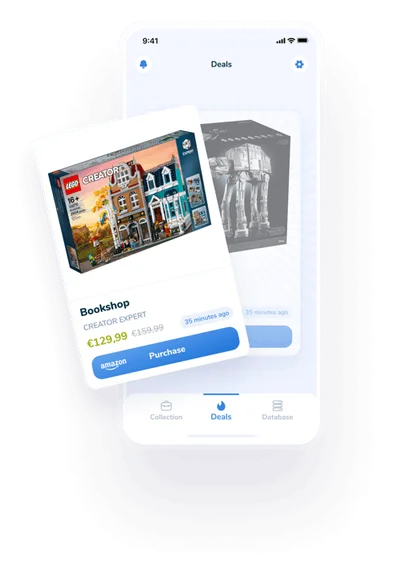
Want to buy Lego® sets at a bargain price? In the Brickfact price comparison you can choose from a variety of suppliers and save money. The Brickfact app is free for iOS and Android and notifies you as soon as a new Lego deal appears.
Lego® valuation: FAQ
Valuing a collection raises the same handful of questions again and again, usually about used sets, boxes and whether the individual parts are worth more. Here are our short answers.
How do I find out what my Lego® set is worth?
Look up the set number in the value checker. It returns the current market value for a sealed copy, shows the change against the launch price, and lets you scale the figure down for condition.
Does Brickfact have a value for every Lego® set?
No. As of August 2026, 12,047 of the 16,234 sets in the database carried a current market value. Very old or barely traded sets often have none, and we would rather show nothing than invent a price.
Is a used Lego® set worth less than a sealed one?
Almost always. As rules of thumb, collectors work with roughly 85% of the sealed value for a built and complete set with its box, around 80% without the box, and 70% or less once pieces are missing.
Are Lego® minifigures valued separately?
Yes, and they are the only part of the data with both a new and a used price. Sets have one sealed price, so every used set figure is an estimate, while a used minifigure price is measured.
Should I part out my Lego® set instead of selling it whole?
Only if you are prepared to list hundreds of items individually. The part-out value is usually higher than the set value, but turning it into money takes months of sorting, listing and posting.
Where should I sell my Lego® once I know the value?
That depends on the set and how quickly you want the money. Our guide to where to sell Lego® compares marketplaces, auctions and local options.