The LEGO® Icons Titanic 10294 is worth buying if you want a substantial building project and can give the finished ship a permanent 53-inch space. Its consistent 1:200 scale, detailed cross-sections and three-part construction make it more than a large shell. The $679.99 US and £589.99 UK list prices are still difficult to justify if the model will have to be packed away after the build.
The investment case is less convincing. Brickfact's current sealed market value is €659.38 as of August 16, 2026, while the set remains available at regular retail in the markets we checked. Brickfact estimates a December 2026 retirement, but LEGO has not announced that date. A collector who intends to keep a sealed copy therefore needs a meaningful discount and enough protected storage for one of LEGO's largest boxes.
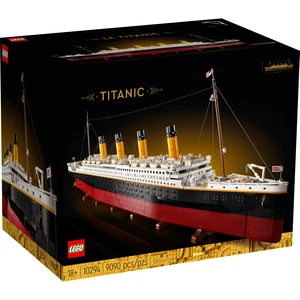
LEGO® Titanic 10294 at a glance
| Specification | Detail |
|---|---|
| Set number | 10294 |
| Theme | LEGO® Icons |
| Pieces | 9,090 |
| Minifigures | None |
| Scale | 1:200 |
| Finished dimensions | 53 × 6 × 17.5 in / 135 × 16 × 44 cm |
| Estimated finished weight | About 16.5 to 17.9 lb / 7.5 to 8.1 kg in independent measurements |
| Boxed weight | 27.9 lb / 12.645 kg in Brickfact data |
| Stickers | None |
| US MSRP | $679.99 |
| UK RRP | £589.99 |
| Brickfact build-time estimate | 20 to 26 hours |
| Release | October 2021 |
| Brickfact retirement estimate | December 2026, not officially confirmed |
Prices, boxed weight, market value and retirement estimate are from Brickfact and were checked on August 17, 2026. LEGO publishes the finished dimensions, piece count, scale and functions. LEGO does not publish a finished model weight, so that figure is a range from independent measurements rather than an official specification.
The short answer: who should buy it?
| Buyer | Our verdict | Main condition |
|---|---|---|
| Titanic or maritime-history fan | Yes | You have a permanent display location |
| Adult builder seeking a long project | Yes | Repeated windows and deck sections do not bother you |
| Family or group build | Yes | The three manuals and ship sections suit parallel building |
| Collector with ordinary shelving | Probably not | The model is too long for most bookcases |
| Child seeking a playset | No | There are no minifigures and limited play functions |
| Short-term investor | No at MSRP | Retirement is unconfirmed and resale costs are substantial |
The unusual point about Titanic is that budget is not the only gate. Someone can afford the set and still make a poor purchase because the completed model has nowhere safe to go. Measure the display location before comparing prices.
How much display space does the LEGO® Titanic need?
LEGO lists the model at 53 inches long, 6 inches wide and 17.5 inches high. Those dimensions describe the model itself, not a practical shelf or case. A bow or stern sitting directly against a cabinet edge is vulnerable whenever the furniture is bumped, and the masts and rigging need room for dusting.
We recommend a usable internal display area of at least:
- 57 × 10 inches with 20 inches of height, or
- 145 × 25 cm with 50 cm of height.
This is a Brickfact planning recommendation, not a LEGO specification. It adds about two inches at each end, two inches on either side and modest clearance above the masts. A case with doors may need more depth so that the door and hinges cannot touch the bow.
The support surface should safely hold at least 20 lb, even though independent finished-weight measurements cluster between roughly 16.5 and 17.9 lb. The extra allowance covers the display base or case and avoids designing a shelf exactly to a non-official weight estimate.
Can the Titanic fit on a normal bookcase?
Usually not. The 6-inch model width sounds narrow, but the 53-inch length exceeds most individual shelving bays. A long sideboard, custom wall shelf or purpose-built acrylic case is more realistic. Check for vertical supports in the furniture: an apparently long shelf may be divided into sections that prevent the ship from fitting.
Can it be moved after building?
Yes, but it should not be carried as one 53-inch model unless the route is clear and two people can support it properly. The ship separates into bow, middle and stern sections. That makes relocation and cleaning more manageable and is one of the design's most useful practical features.
Before construction, confirm that each section can travel through doors and around corners without touching the masts or rigging. It is much easier to assemble the three sections near their permanent display area than to improvise after completion.
For a personal build, we would choose a complete used copy with a damaged box over a more expensive collector-grade package. The three hull sections, stands, rigging, instructions and decorated name elements matter most. Parts already sorted by building stage add more practical value than flawless cardboard.
How long does the LEGO® Titanic take to build?
Plan for 20 to 25 hours if you are an experienced adult builder working at a comfortable pace. Brickfact estimates 20 to 26 hours. Published hands-on accounts vary much more widely, from about 11 hours for a fast reviewer to well over 20 hours for builders who sort carefully, pause frequently or share the project. One outlying estimate reaches 40 to 50 hours.
That spread is not a contradiction. Build-time reports measure different things: some exclude sorting and breaks, while others record every session. A useful personal plan is:
- 15 to 18 hours for a fast, focused builder;
- 20 to 25 hours for a measured solo build;
- 25 hours or more when building slowly, filming or sharing the experience.
The set is divided into 46 numbered stages and three major hull sections, each with its own instruction book. Three people can work on separate sections in parallel. The final joining step still needs a flat surface long enough for the complete ship.
Is the build repetitive?
Parts of it are. More than 300 portholes, long deck runs and symmetrical hull details inevitably repeat. The repetition is distributed among changing structural tasks, including angled hull work, cross-sections, engines, decks, funnels and rigging. We think its reputation as a uniformly monotonous build is overstated. It is better described as an endurance build than a technically punishing one.
Buyers who dislike repeated windows and tiled surfaces should not assume that the historic subject will remove that frustration. Builders who enjoy gradual visual progress are more likely to find the rhythm satisfying. Titanic also appears in our guide to the hardest LEGO® sets to build, where time and sustained concentration matter more than advanced mechanisms.
What makes the model more than a long display shell?
The 1:200 scale is internally coherent. The real Titanic was about 269 metres long; divided by 200, that becomes 134.5 cm, almost exactly the model's published 135 cm length. The same calculation puts the historic ship's beam close to the LEGO model's main hull width. That consistency is a meaningful strength for a scale model.
Separating the three sections reveals partial interiors, including the grand staircase, first-class dining room, cabins, boiler room, smoking lounge, reading room and swimming pool. These are cutaway impressions rather than a continuous minifigure-scale interior. Much of the detail disappears when the sections are connected, but it gives the construction more variety and makes separation rewarding.
The propellers drive piston engines inside the stern, the tension line between the masts can be adjusted, and stands support all three sections. Lettering and decorative details are printed or brick-built; there is no sticker sheet. The lack of minifigures is appropriate at 1:200 scale but removes almost all conventional play value.
The biggest strengths and weaknesses
| Strengths | Weaknesses |
|---|---|
| Consistent 1:200 scale and convincing silhouette | 53-inch length rules out most ordinary shelves |
| Three sections make the build and later movement manageable | MSRP is high even before a display case is added |
| Cross-sections and working engine connection add substance | Repeated portholes and decks will not suit every builder |
| Three instruction books support a group build | Almost no play value and no minifigures |
| No sticker sheet | Large box is expensive to store and ship |
The visual impact is the primary value. If that impact will be hidden in storage, the strengths do not justify the cost. Conversely, a maritime fan with a dedicated shelf receives a display piece unlike almost any other LEGO set.
What is a sensible price for Titanic 10294?
At the time of research, LEGO listed the set at $679.99 in the US and £589.99 in the UK. Brickfact's sealed market value was €659.38 on August 16, 2026. Converted using Brickfact's same-day exchange rates, that is roughly $762 or £564. The converted figure is a cross-market valuation, not a guaranteed local sale price or retailer offer.
The following thresholds are more useful for a buyer than the converted market value:
| Discount from MSRP/RRP | US target | UK target | Best suited to |
|---|---|---|---|
| 0% | $679.99 | £589.99 | Immediate build when availability matters more than price |
| 10% | $611.99 | £530.99 | Reasonable target for a planned personal build |
| 15% | $577.99 | £501.49 | Better margin for a sealed collection or patient buyer |
These are editorial thresholds calculated from list price, not promises that a retailer will offer them. The live deals and price history belong on the Brickfact Titanic set page, where they can update without making this article pretend that a temporary offer is permanent.
At MSRP, the model costs about 7.5 US cents or 6.5 UK pence per piece. That ratio looks competitive for a licensed display model, but price per piece cannot measure the cost of the required furniture, the value of the finished silhouette or whether the repeated small elements suit you.
Is LEGO® Titanic 10294 a good investment?
Not at full price for a short holding period. The set has qualities that may support long-term collector demand, but the cost structure is unfavorable:
- it has been sold since 2021, giving investors years to accumulate sealed copies;
- the large box consumes significant dry, dark storage space;
- shipping is expensive and increases damage risk;
- there are no exclusive minifigures that can create separate demand;
- LEGO could revisit the subject in a different scale in the future;
- Brickfact's December 2026 retirement estimate is not an official announcement.
The broad international recognition of Titanic, the unusually consistent scale and the model's display presence are genuine positives. They do not remove fees or guarantee appreciation after retirement.
Break-even prices after selling fees
The table shows the minimum resale price needed to recover the original purchase after percentage-based platform costs. Shipping, packaging and time are still excluded.
| Entry price | No fees | With 10% fees | With 15% fees |
|---|---|---|---|
| $679.99 MSRP | $679.99 | $755.54 | $799.99 |
| $611.99 at 10% off | $611.99 | $679.99 | $719.99 |
| $577.99 at 15% off | $577.99 | $642.21 | $679.99 |
For a UK buyer, a £589.99 entry requires a sale at roughly £655.54 with 10% fees or £694.11 with 15% fees merely to recover the purchase. Buying at £501.49 lowers those break-even points to about £557.21 and £589.99.
This is why a discount matters more than an optimistic growth forecast. The Part Out Value does not solve the problem either. Brickfact records €1,083.81 / $1,253.54, but that is the theoretical sum of individual part values. Reaching it would require sorting thousands of pieces, filling many separate orders and absorbing fees and unsold inventory. Our Part Out Value guide explains why it is not the cash value of an intact set.
Should you rush because of retirement rumors?
No. Brickfact currently estimates December 2026, while LEGO has not officially confirmed a retirement date. The set was still offered through official regional product pages when this article was checked on August 17, 2026.
A better buying signal combines several observations:
- LEGO labels the product as retiring soon or last chance.
- Retailer availability falls for a sustained period.
- Discounts disappear while demand remains visible.
- Official stock stops returning after sell-outs.
One predicted date is not enough to create urgency. A builder can reasonably buy at a good price before retirement; an investor should not use an unconfirmed month as proof of imminent scarcity.
Final verdict
LEGO® Titanic 10294 succeeds as a major building project and museum-like display model. The scale is coherent, the sectional construction gives the interior a purpose, and the finished silhouette has unusual presence. For a Titanic enthusiast with a measured 57-inch display area, it can justify a premium purchase.
It is a poor impulse buy. Without permanent space, the model's defining advantage becomes a storage problem. At full price, it is also a weak speculative purchase because retirement remains unconfirmed and the box creates high storage and resale costs.
Our buying line is simple: buy to build around 10% below MSRP/RRP if possible; require about 15% off for a sealed collection; do not buy solely because of a retirement estimate. You can monitor the current value later with the LEGO® Value Checker.
Sources and methodology
Piece count, scale, finished dimensions, functions and official regional prices were checked against the official LEGO® Titanic product page. Brickfact supplied the current market value, 12-month market range, boxed weight, Part Out Value and retirement estimate from its 10294 dataset, checked on August 17, 2026.
Build time, finished weight and the character of the build were compared across multiple independent hands-on reviews and measurements. Competitor pages were used only for internal research and are intentionally not linked here. This article is a data-based buying analysis, not our own hands-on test.
LEGO® Titanic 10294 FAQ
How big is the LEGO® Titanic 10294?
It measures 53 inches long, 6 inches wide and 17.5 inches high, or 135 × 16 × 44 cm. For safer display and cleaning, we recommend at least 57 × 10 inches with 20 inches of internal height.
How much does the completed LEGO® Titanic weigh?
LEGO does not publish a finished weight. Independent measurements place the completed model at roughly 16.5 to 17.9 lb, or 7.5 to 8.1 kg. Brickfact's 27.9 lb figure is the complete boxed set and must not be confused with the built ship.
How long does LEGO® Titanic take to build?
Allow about 20 to 25 hours for a comfortable solo build. Fast reviewers have completed it more quickly, while careful builders can take considerably longer.
Can three people build LEGO® Titanic together?
Yes. The set has three major ship sections and three instruction books, so separate builders can work in parallel. The sections must eventually be joined on a flat surface long enough for the full model.
Does LEGO® Titanic have stickers?
No. The decorative details are printed or built from pieces, so there is no sticker sheet to apply during the build.
Can LEGO® Titanic float?
No. It is a brick-built display model, not a watertight toy or working model boat. Putting it in water risks damaging the set and does not reproduce the buoyancy of a solid hull.
Is LEGO® Titanic retiring in 2026?
Brickfact estimates December 2026, but LEGO has not officially confirmed that date. Treat it as a planning estimate and watch official last-chance labeling and sustained stock changes.
Is LEGO® Titanic a good investment?
Not at MSRP for a short holding period. A 10% to 15% discount improves the cost basis, but storage, shipping, fees, long retail availability and an unconfirmed retirement date remain material risks.