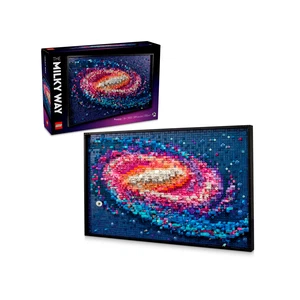
LEGO® Art The Milky Way Galaxy 31212 is worth it for space and design fans who want wall art rather than a conventional model. The 3,091-piece build creates real depth, includes recognizable astronomical references and splits into five panels that can be built by different people. It is less suitable for renters who cannot use dependable wall fixings or anyone who dislikes dusting intricate surfaces.
At $199.99 in the US and £169.99 in the UK, it is not an automatic buy. Brickfact's market value was €152.24 on August 16, 2026, equivalent to about $176 or £130 using the same-day exchange rates. That gap shows why waiting for a discount is reasonable while the set remains widely available.
- 3,091 pieces
- 26 × 16 in wall art
- Five buildable panels
- MSRP: $199.99 / £169.99
LEGO® The Milky Way Galaxy 31212 specifications
| Specification | Detail |
|---|---|
| Set number | 31212 |
| Theme | LEGO® Art |
| Pieces | 3,091 |
| Finished dimensions | 25.5 × 15.5 × 2 in / 65 × 40 × 5 cm |
| Maximum depth reported in hands-on reviews | About 2.4 in / 6 cm from the wall |
| Panels | Five, with separate instruction books |
| Hanging points | Two integrated hanger elements |
| Boxed weight | 7.86 lb / 3.566 kg in Brickfact data |
| US MSRP | $199.99 |
| UK RRP | £169.99 |
| Release | May 2024 |
| Brickfact retirement estimate | December 2026, not officially confirmed |
Product facts and prices were checked on August 17, 2026. The 7.86 lb figure is the complete packaged set, not a verified finished-artwork weight. LEGO does not publish the completed weight, so wall hardware should never be selected by treating the boxed figure as an exact substitute.
Our verdict by use case
| What you want | Verdict | Why |
|---|---|---|
| Distinctive wall art for a home office | Recommended | Color and depth remain interesting from different distances |
| A shared adult build | Recommended | Five panels and instructions divide the work naturally |
| A relaxing one-evening set | Maybe | Some builders finish quickly, but the detailed placement can feel fiddly |
| A desk or shelf display | Not ideal | It is designed to hang and uses a large horizontal footprint |
| A low-maintenance decoration | No | The exposed 3D texture catches dust |
| A short-term investment | No at MSRP | Current market value is below list price and retirement is unconfirmed |
The set's strongest quality is not accuracy in the scientific-model sense. It is an artistic interpretation that uses LEGO elements as brushstrokes. Buyers expecting a literal astronomical map may find the colors and playful parts too abstract. Buyers who enjoy noticing helmets, leaves, brushes and other unexpected pieces embedded in the galaxy are the intended audience.
How much wall space does set 31212 need?
LEGO lists the finished work at 25.5 inches wide, 15.5 inches high and 2 inches deep. Independent measurements put the deepest elements closer to 2.4 inches from the wall. A tight recess that is exactly 2 inches deep is therefore a poor choice.
For comfortable installation and cleaning, we recommend reserving at least:
- 30 × 20 inches of clear wall area, or
- 75 × 50 cm.
That allowance leaves visible breathing room around the black frame and enough hand access to lift the work onto or off its fixings. It is a planning recommendation, not a product dimension.
The artwork is much wider than a standard framed photo but far easier to place than the longest LEGO ships or cars. Its shallow profile is an advantage in hallways and home offices, provided people cannot brush against the protruding pieces.
How should you hang the LEGO® Milky Way safely?
The model includes two hanger elements at the back. Use both. The completed artwork is not evenly balanced, and a single central hook would allow it to lean. Two level mounting points also spread the load and keep the frame from rotating.
A safe installation sequence is:
- Finish all five panels and lock them into the frame on a flat surface.
- Check every Technic connection and confirm that no panel has lifted.
- Measure the distance between the two hanger centers instead of guessing from the front.
- Mark a level horizontal line on the wall.
- Choose screws, anchors or hooks rated for the wall material and comfortably above the artwork's actual weight.
- Lift the model with two hands and verify that both hangers are fully seated.
Drywall, masonry and timber studs require different fixings. Follow the hardware manufacturer's load rating and installation method. In a rental home, ask the property owner before drilling. Adhesive strips are only reasonable if their maker explicitly rates the exact product for the surface, load and protruding object; the cost of a failed fixing is a 3,091-piece fall.
Can the five panels separate while it is hanging?
The final structure is more secure than five loose pictures. The 15 square sections connect with color-coded plates and Technic pins, then sit inside a frame and lock into place. Multiple hands-on builds describe the completed assembly as sturdy. The risk is more likely to come from incomplete final connections or unsuitable wall hardware than from the intended panel system.
Still, do not carry the finished artwork by one side of the frame. Support it at two points and keep it upright when moving it to the wall.
How long does The Milky Way Galaxy take to build?
A realistic planning range is four to seven hours. Fast reviewers have reported about three to four hours, while a careful two-person community build took around eight. The difference comes from sorting, pace and how often the builder stops to inspect the many small decorative choices.
The build consists of a black frame plus 15 squares arranged as five vertical strips. Each square can take roughly 15 to 20 minutes in a focused build. The sections do not look like a complete galaxy immediately, which makes the reveal more gradual than a typical vehicle or building.
Is the build repetitive?
It repeats a process, but not a simple pattern. Each square receives dense layers of small elements in different colors and heights. That demands attention and can feel fiddly, yet it avoids the long runs of identical studs found in early mosaic-style LEGO Art sets.
We see this as a sorting-heavy texture build rather than a conventional model that steadily reveals a vehicle or building. The unusual pieces keep it interesting, but buyers who dislike organizing many small elements should not expect a relaxing standard mosaic.
The unusual element choices create much of the enjoyment. The artwork includes representations of TRAPPIST-1, the Pleiades, the Crab Nebula, the Pillars of Creation and the Gaia space telescope, alongside a printed "You are here" tile and a hidden green alien. The five instruction books also link to an official audio series about the galaxy.
For a group, the divided structure is excellent: up to five builders can complete separate strips before combining them. For a solo builder, one panel per session creates natural stopping points.
What does it look like in a real room?
From across a room, the color gradients and bright galactic center create the main image. At close range, the illusion breaks into hundreds of recognizable LEGO objects. That two-distance effect is the reason the set works better than a flat printed poster for many buyers.
The completed model looks better than the official images suggest. Side lighting reveals shadows and depth that front-facing product photography flattens, and that physical relief is the strongest reason to choose the LEGO version over an ordinary galaxy print.
The trade-off is visual density. In a room that already has busy wallpaper, shelves and colorful collectibles, the artwork can become noise rather than a focal point. A plain wall with indirect light gives the shape and shadows more room to work.
Direct sunlight is a poor location. Long exposure can fade or discolor plastic and may heat the model unevenly. Avoid damp walls and positions above radiators as well.
The dust problem is real
The layered design has hundreds of ledges and crevices. Dust will be more visible on the black frame and can settle between bright pieces where a flat cloth cannot reach. This is the largest long-term drawback and appears consistently in practical reviews.
The least disruptive cleaning routine is:
- use a soft, clean makeup brush or camera-cleaning brush for loose dust;
- support the frame with the other hand instead of pressing it against the wall;
- use low suction only if a mesh barrier prevents loose pieces entering a vacuum;
- avoid household sprays, solvents and soaked cloths;
- remove the artwork for a deeper clean rather than working above shoulder height.
A clear acrylic cover reduces dust but adds cost, reflections and weight. It also changes the wall-hardware requirement. Buyers who know they will never clean textured display pieces should count this maintenance burden before purchasing.
Price analysis: what should you pay?
Brickfact recorded a sealed market value of €152.24 on August 16, 2026. That equals roughly $176 or £130 at the same day's exchange rates. The 12-month euro market range ran from €143.75 to €174.07, with an average of €152.24. In other words, the list price is not the only realistic reference point.
| Buying level | US price | UK price | Our view |
|---|---|---|---|
| MSRP/RRP | $199.99 | £169.99 | Acceptable only if you want it now and local discounts are unavailable |
| 10% discount | $179.99 | £152.99 | Reasonable for a planned personal build |
| 15% discount | $169.99 | £144.49 | Strong buying target |
| 20% discount | $159.99 | £135.99 | Excellent relative to the recent Brickfact market range |
Brickfact showed a UK offer at £139.99 on August 17, 2026, approximately 17.6% below RRP. The US offers in our current feed were still at MSRP. Offers change, so use the Brickfact set page for 31212 for the live comparison rather than relying on an article snapshot.
At list price, the set costs about 6.5 US cents or 5.5 UK pence per piece. The ratio is favorable on paper, but the 3,091-piece total includes many tiny decorative elements. Judge the purchase as a 26-inch artwork and several hours of building, not as bulk plastic.
Is The Milky Way Galaxy retiring?
Brickfact estimates December 2026 and labels the set as a longer-term product in its current data. LEGO's US product page still showed it as available when checked on August 17, 2026. LEGO has not publicly confirmed the Brickfact retirement month.
The distinction matters because third-party retirement lists can change repeatedly. A prediction is useful for planning, not evidence that stock will vanish on a fixed date. Watch for official last-chance labeling and sustained retailer stock loss before paying a premium.
If you want the set to build, a discount in the 15% range is more important than guessing the final month perfectly. If you want it sealed as an investment, the uncertainty is one more reason to demand a lower entry price.
Does set 31212 make sense as an investment?
Not at full price. The current market value sits below MSRP/RRP, the set remains available and LEGO Art models have a narrower resale audience than the largest licensed vehicles or buildings. Wall art also depends strongly on interior-design taste.
Potential positives include a distinctive subject, broad interest in space, an unusual three-dimensional technique and a manageable sealed box compared with giant collector sets. Risks include long availability, possible future space-themed wall art, limited minifigure value and the need to ship a broad box without crushing it.
Brickfact's Part Out Value is €272.88 / $315.61, but dismantling a complete set into 3,091 inventory items is not a shortcut to that sum. Sales fees, labor and slow-moving pieces reduce the practical return. Our guide to parting out LEGO® sets explains the workload behind the theoretical number.
For an ordinary collector, the better reason to buy is the finished artwork. Anyone tracking a sealed copy can use the LEGO® Value Checker after retirement rather than treating a forecast as guaranteed growth.
Final verdict
LEGO® The Milky Way Galaxy 31212 earns its place on a wall because it changes character with viewing distance. The five-panel system makes construction shareable, the texture avoids the flatness of a mosaic, and the finished dimensions are large without demanding custom furniture.
Its weaknesses are practical rather than hidden: it needs two secure mounting points, collects dust and offers no play value. At $199.99 or £169.99, those drawbacks make patience worthwhile. A price around $170 or £145 is our preferred target, with a lower price especially attractive for buyers who already know where it will hang.
Sources and methodology
Dimensions, piece count, five-panel design, hanging elements and audio content were checked against the official LEGO® product page for set 31212 and LEGO's official product announcement. Price, boxed weight, market history, Part Out Value and retirement estimate came from Brickfact data checked on August 17, 2026.
Build time, assembly behavior, wall balance and dust concerns were compared across more than five independent written, video and community reports. Competitor pages informed the analysis but are intentionally not linked in the published article. This is a data-based buying analysis, not our own hands-on test.
LEGO® The Milky Way Galaxy 31212 FAQ
How big is LEGO® The Milky Way Galaxy?
LEGO lists it at 25.5 inches wide, 15.5 inches high and 2 inches deep, or 65 × 40 × 5 cm. Some hands-on measurements put the deepest pieces about 2.4 inches from the wall.
How many hooks does set 31212 need?
Use two mounting points for the two integrated hanger elements. The model is not evenly balanced around one central point, and two correctly leveled fixings provide better stability.
How heavy is the completed LEGO® Milky Way?
LEGO does not publish a finished weight. Brickfact lists the complete boxed set at 7.86 lb / 3.566 kg, but that includes packaging and instructions and should not be treated as the exact hanging weight.
How long does LEGO® Milky Way 31212 take to build?
Plan for about four to seven hours. Fast reviewers report roughly three to four hours, while careful or shared builds can reach eight hours.
Can several people build set 31212 together?
Yes. Five separate panel strips have their own instruction books, so up to five people can build sections before combining them in the frame.
Is the LEGO® Milky Way difficult to clean?
It requires more care than flat wall art because dust settles between protruding elements. A soft brush and regular light cleaning are safer than waiting for a heavy buildup.
Is LEGO® The Milky Way Galaxy retiring in 2026?
Brickfact estimates December 2026, but LEGO has not officially confirmed that month. The set was still available from LEGO when checked on August 17, 2026.
Is LEGO® Milky Way 31212 worth the money?
It is worth considering around 15% below list price if you want textured space-themed wall art and have a secure mounting location. At full price, the current market data suggests there is little reason to rush.