LEGO® Icons Back to the Future Time Machine 10300 is worth buying for a fan of the trilogy who wants one definitive LEGO DeLorean. The 1,872-piece car includes gull-wing doors, folding hover wheels, an illuminated flux capacitor and parts for the 1985, 2015 and 1885 versions. Its largest weakness is that only one film configuration can be assembled at a time.
The set's later recorded prices were $199.99 / £169.99, while Brickfact valued a sealed copy at €154.32 on August 16, 2026. Remaining retailer stock and marketplace prices vary, making about $170 / £145 our preferred ceiling for a new build copy.
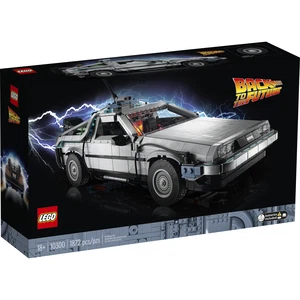
- 1,872 pieces
- 14 × 8 × 5 in car
- Three movie configurations
- Doc and Marty minifigures
Back to the Future 10300 specifications
| Specification | Detail |
|---|---|
| Set number | 10300 |
| Theme | LEGO® Icons |
| Pieces | 1,872 |
| Minifigures | Doc Brown and Marty McFly |
| Dimensions | 5 × 14 × 8 in / 12 × 35 × 19 cm |
| Display configurations | Parts for films I, II and III; one at a time |
| Boxed weight | 4.72 lb / 2.142 kg in Brickfact data |
| Later US / UK list price | $199.99 / £169.99 |
| Release | April 2022 |
| Brickfact lifecycle estimate | December 2025; check remaining regional stock |
Data and prices were checked on August 17, 2026. The boxed weight includes instructions and packaging.
The decision in one table
| Buyer | Verdict |
|---|---|
| Fan of all three films | Highly recommended below retail |
| Collector who only wants the clean 1985 DeLorean | Recommended |
| Buyer expecting three complete cars | No |
| Technic fan seeking steering and suspension | Maybe |
| Child wanting a minifigure-scale vehicle | Choose a smaller set |
| Sealed investor at full marketplace price | Cautious |
The car is larger than minifigure scale. Doc and Marty stand beside it as collectible markers rather than fitting naturally into a proportional cabin. The enlarged scale allows the movie equipment and stainless-steel body shape to read more clearly.
Which film version should you build?
Back to the Future Part I: the cleanest silhouette
The first-film configuration uses the plutonium reactor and includes the lightning hook for the clock-tower finale. Standard black wheels preserve the closest resemblance to the original DeLorean road car. This is our best default for buyers who value the body shape over extra equipment.
Display it with the plutonium case and the 1985 license plate. The long hook adds narrative but also increases the model's practical length and can snag during cleaning, so many owners store it separately outside a scene.
Part II: the most functional display
The second-film version adds Mr. Fusion, the orange 2015 plate and folding wheels. A lever underneath rotates all four wheels into hover mode together. That synchronized mechanism is the set's most satisfying function and gives the car a dramatically different shelf profile.
Marty's hoverboard belongs naturally beside this configuration. The downside is height: wheels turned flat need clearance below and look best if the model is raised on a secure stand. LEGO does not include a flying display stand. We consider that the set's largest display omission because the hover mode never looks fully resolved without a safe raised support.
Part III: the busiest historical version
The 1885 configuration adds whitewall tires, hood-mounted electronics and different equipment for the Old West finale. It is visually dense and immediately recognizable to trilogy fans, but it covers some of the clean hood lines and makes the model less obviously a stock DeLorean to casual viewers.
Choose it if the train sequence or third film is your favorite. Otherwise, keep its unique parts together in a labeled bag so they are not lost between conversions.
How difficult is conversion?
The three versions share almost the entire vehicle. Conversion involves removing and rebuilding smaller assemblies, changing wheels or tires, swapping plates and altering the reactor or hood equipment. It is a short rebuild, not an instantaneous mode switch.
Allow 20 to 40 minutes for a careful change while consulting the relevant instruction pages. Store unused parts by version. The tiny license plates and whitewall wheel elements are easy to misplace, and replacing a unique decorative component later can be expensive.
That is too involved for a casual switch every time the display changes. Our recommendation is to choose one default movie version and treat the other two as occasional rebuilds, not instant modes.
The wheel-folding function remains integrated into the chassis. Switching back to road mode uses the same lever rather than dismantling the suspension assembly.
Build quality and functions
Both gull-wing doors open, the hood and rear equipment are accessible, and a light brick illuminates the flux capacitor behind the seats. The dashboard displays time-circuit dates, while exterior cables and printed or stickered details recreate the improvised technology.
The hover conversion is clever and reliable when all wheel assemblies are aligned. Do not force the lever if one wheel catches; inspect the linkage and position instead. The steering wheel does not control the front wheels, and the model lacks the deep mechanical functions of a similarly priced Technic supercar.
Panel gaps are visible around the doors and rear because System elements approximate a low stainless-steel body. Light bluish gray is not a metallic finish, but it keeps color consistent across the many slopes. The dark windshield shape and angled nose carry the identity better than surface color alone.
Stickers and light brick
The set uses a relatively small sticker sheet alongside printed elements. Fine dashboard and equipment labels reward careful alignment. A light brick provides the flux-capacitor effect, but it only stays illuminated while the control is pressed; it is not a continuously powered lighting system.
Batteries can eventually deplete or leak. If the set is stored for years, inspect the light element according to LEGO's instructions and keep moisture away. A third-party lighting kit may offer continuous effects but adds wiring and is outside the original design.
How long does set 10300 take to build?
Plan for six to nine hours. A fast experienced reviewer may finish earlier, while community builds with careful sorting can reach around ten. Thirteen numbered bag groups and a long instruction book create comfortable session breaks.
The chassis and synchronized wheel mechanism form the technical core. Bodywork then adds offset slopes, doors and dense rear machinery. Repeated gray panels are limited, and the gradual transformation into a recognizable car keeps the sequence engaging.
This is a moderately advanced System build. It demands attention to linkage orientation, but it does not require understanding Technic geometry independently from the instructions. Converting to a second film version after completion also reinforces how the subassemblies work.
Display space and care
LEGO lists about 35 cm long, 19 cm wide and 12 cm high. Reserve 18 × 11 × 9 inches, or 46 × 28 × 23 cm, to include the figures, accessories and safe hand clearance. Part I's lightning hook needs additional length if attached.
The car's low shape fits ordinary shelves and is easier to case than the largest licensed vehicles. Dust collects around rear cables, cabin edges and the exposed flux equipment. Use a soft brush, support gull-wing doors while cleaning and avoid pressing on the windshield edges.
Display out of direct sunlight to reduce discoloration. Light bluish gray panels can show contrast if individual elements age differently, and transparent parts reveal scratches under strong light.
Price analysis
Brickfact's sealed market value was €154.32 on August 16, 2026. Its previous 12-month range ran from €150.88 to €165.72, with a €158.44 average. That stable band remained below the later €199.99 list price.
| Price level | US | UK | Our view |
|---|---|---|---|
| Later list price | $199.99 | £169.99 | Too high where discounted stock exists |
| 10% off | $179.99 | £152.99 | Fair |
| 15% off | $169.99 | £144.49 | Strong target |
| 20% off | $159.99 | £135.99 | Excellent for new and sealed |
Brickfact showed a German offer near €184 delivered and a US offer at $159.99 on August 17, while the UK record was older and less reliable. The mismatch shows why the live 10300 comparison matters more than a converted global average.
For a used copy, verify the alternative wheels, whitewall tires, lightning hook, Mr. Fusion, license plates, hoverboard, plutonium case and both figures. A completed Part II car may look whole while missing most Part III conversion parts.
Retirement and investment potential
Brickfact's lifecycle record points to December 2025, but official regional product pages remained accessible in August 2026 and marketplace stock varied. An accessible page is not proof of direct stock. Confirm the purchase button and seller type for the delivery country.
The model has strong long-term recognition, two desirable figures and the unusual ability to represent an entire trilogy. Risks include future DeLorean versions, a high list price, remaining discounted inventory and the cost of proving all loose conversion pieces are present on resale.
Brickfact's Part Out Value was €268.61 / $310.67. That is not a quick resale value; it assumes individual parts can be sold before labor and fees. A sealed investment makes more sense at $160–170 than near $200.
Final verdict
LEGO® Back to the Future Time Machine 10300 respects the trilogy by making the owner choose and rebuild each era. Part I gives the cleanest car, Part II the best mechanical display, and Part III the most distinctive equipment. The conversion compromise is preferable to permanently combining incompatible film details.
Strong functions, moderate dimensions and two figures make this one of the easiest licensed Icons cars to recommend. Target roughly $170 / £145 or less, and treat a complete used copy with all version parts as a legitimate alternative to sealed stock.
Sources and methodology
Dimensions, three configurations, piece count and figures were checked against LEGO's official announcement for set 10300 and current official regional product pages. Brickfact supplied price history, offers, boxed weight, Part Out Value and lifecycle data checked August 17, 2026.
Build duration, panel gaps, conversion process and mechanism behavior were compared across more than five independent reviews and owner reports. Competitor pages are not linked from the article. This is a research-based buying analysis rather than a Brickfact hands-on test.
LEGO® Back to the Future 10300 FAQ
Can set 10300 build all three DeLoreans at once?
No. One shared car can be converted among the three film versions. The box does not contain three complete vehicles.
Which version is best?
Part I has the cleanest silhouette, Part II offers the folding hover wheels and Mr. Fusion, and Part III has the most distinctive hood equipment and whitewall tires.
How long does LEGO® 10300 take to build?
Plan for six to nine hours. Careful builders and first-time conversions may take longer.
Does the flux capacitor light up?
Yes. A light brick illuminates it when pressed. It does not remain continuously powered without modification.
Do the wheels fold into hover mode?
Yes. An integrated lever rotates all four wheels for the Part II configuration.
How big is the LEGO® Time Machine?
It measures about 14 inches / 35 cm long, 8 inches / 19 cm wide and 5 inches / 12 cm high.
What should I check when buying set 10300 used?
Confirm both figures and all alternate-version parts, especially wheels, whitewall tires, plates, lightning hook, Mr. Fusion, hood equipment and accessories.