
Calling one Lego® set “the best” is inevitably an editorial judgement. A display model, a playset, a mechanical Technic build and a small Creator box do different jobs, so sheer size cannot settle the question. This refresh now uses one ranked top 10 shared by all four Brickfact languages. It rewards what each set achieves on its own terms rather than treating piece count, current price or aftermarket value as a shortcut for quality.
The shortlist ranges from a 174-piece Creator set to a 7,541-piece collector model. That spread is deliberate. Some choices sustain a long, varied build; others turn a modest inventory into several expressive models. Retired sets remain eligible, because an all-time ranking would make little sense if it followed the current shop catalogue. Useful links to related Brickfact guides are retained where they help, including our lists of the biggest Lego Star Wars sets, biggest Lego NINJAGO sets, and tallest Lego sets.
How we chose and scored the 10 sets
The eligibility cutoff is 30 June 2026 (2026-06-30). Consumer Lego construction sets released by that date may qualify whether current or retired. We excluded books, gear, bundles, collectible-minifigure series, education-only kits, event exclusives and products that had only been announced. A remake is treated as part of one design lineage: the strongest complete edition represents that lineage, while an older edition can still contribute to its historical significance. No licensed franchise may take more than two positions.
We built a 33-set candidate pool independently of the old article. Searches covered classic original themes, licensed models, modular buildings, Technic flagships, Ideas projects, large playsets, compact Creator sets, recent releases, remakes and near-cutoff favourites. LEGO building-instruction records supplied official names, years and published piece counts; an independent catalogue checked identity, theme and inventory. Medieval Market Village 10193 was removed from the final selection because the available first-party locale records and catalogue did not agree on its piece count. We did not print a value we could not resolve.
The boundary was challenged rather than accepted after scoring the first ten familiar names. We specifically checked pre-2000 flagships, original Space and Pirates designs, later modular buildings, current Icons releases, large Technic cranes, licensed landmarks, and smaller Creator models. Near misses included excellent sets whose functions overlapped more strongly with a higher-scoring representative, remakes already covered by the one-lineage rule, and candidates whose verified facts were not complete enough for publication. The final group spans 1999 to 2022, licensed and original themes, vehicles and buildings, low-cost rebuilding and premium display. That range does not award automatic diversity points; it confirms that the score has not accidentally become a ranking of only recent, enormous adult boxes.
Candidates were retained in the research record even when excluded, so the cutoff can be challenged again without silently treating this article as the complete universe.
Each candidate received six inputs on a 0–5 scale in 0.5-point steps. The weights are building and design 25%, innovation and function 20%, play and display 20%, cultural influence 15%, durable appreciation 15%, and value at release 5%. The weighted result is shown on a 100-point scale. These are editorial inputs, not user ratings, and every input needed to reproduce each total appears in the table.
The tie-break is mechanical: first the higher building-and-design input, then innovation-and-function, then the earlier release year, and finally the lower set number. Repeated community observations were used only as a challenge to experiential judgements, never as a vote or as authority for product specifications. Sparse comments, price chatter and isolated anecdotes did not change a score. We also made a final balance check across themes, eras, budgets, play and display, without changing the declared arithmetic after seeing the order.
| Rank | Set | Year | Pieces | Build/design | Innovation/function | Play/display | Cultural influence | Lasting appeal | Value | Score |
|---|---|---|---|---|---|---|---|---|---|---|
| 1 | 70620 NINJAGO® City | 2017 | 4,867 | 5 | 5 | 5 | 4.5 | 4.5 | 3 | 95 |
| 2 | 10305 Lion Knights' Castle | 2022 | 4,514 | 5 | 4.5 | 5 | 4.5 | 4.5 | 3.5 | 93.5 |
| 3 | 21322 Pirates of Barracuda Bay | 2020 | 2,545 | 4.5 | 5 | 5 | 4.5 | 4.5 | 4 | 93.5 |
| 4 | 21309 LEGO® NASA Apollo Saturn V | 2017 | 1,969 | 4.5 | 4.5 | 4.5 | 4.5 | 5 | 5 | 92 |
| 5 | 10497 Galaxy Explorer | 2022 | 1,254 | 4.5 | 4.5 | 4.5 | 5 | 4.5 | 5 | 92 |
| 6 | 10196 Grand Carousel | 2009 | 3,263 | 4.5 | 5 | 4.5 | 4.5 | 4.5 | 3 | 90.5 |
| 7 | 75192 Millennium Falcon™ | 2017 | 7,541 | 5 | 4.5 | 4 | 5 | 4.5 | 2 | 89.5 |
| 8 | 10243 Parisian Restaurant | 2014 | 2,469 | 5 | 4 | 4 | 4.5 | 5 | 4 | 89.5 |
| 9 | 8448 Super Car | 1999 | 1,408 | 4.5 | 5 | 4 | 4.5 | 4.5 | 4 | 89.5 |
| 10 | 31058 Mighty Dinosaurs | 2016 | 174 | 4 | 4.5 | 5 | 4 | 4.5 | 5 | 88.5 |
1. LEGO® NINJAGO® City 70620
NINJAGO City earns first place because its architecture is also its play system. The model rises through contrasting street, commercial and roof levels, connected by an exposed lift that gives the tall structure a clear route from bottom to top. Water, old masonry, patched-together shops, signs and bright modern additions make every elevation different. The build keeps changing scale and technique instead of repeating one façade, yet the densely layered result still reads as one improbable city block.
Its rooms are small but purposeful. Market stalls, food counters, a comic shop and domestic spaces give the minifigures reasons to move through the building, while bridges, ladders and balconies make the exterior part of the action. The set can be approached as a display full of visual jokes or opened up scene by scene for play. That ability to satisfy both uses without hiding all the interior detail behind a single removable wall is a major reason for its perfect play-and-display input.
Released in 2017 with 4,867 pieces, set 70620 also changed expectations for what a NINJAGO location could be. Later city sets expanded the format, but this first model established the vertical, mixed-age city language and remains complete on its own. Its footprint is substantial and the concentration of colour can be visually busy, which will not suit every shelf. Those are practical trade-offs rather than design failures: few sets turn structural complexity, minifigure storytelling and an adventurous build into such a coherent whole.

- NINJAGO® City
- Year: 2017
- Pieces: 4,867
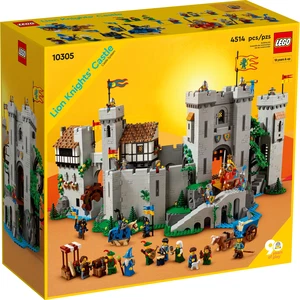
2. LEGO® Lion Knights' Castle 10305
Lion Knights' Castle is a modern castle that behaves like a classic playset. Hinged sections change the silhouette from an enclosed stronghold to a long accessible wall, and the gatehouse combines a drawbridge, portcullis and hidden passages with rooms that remain easy to reach. The rocky base, asymmetric towers, trees and varied roof lines prevent the model from becoming a grey box. Building it alternates between landscape, masonry, timbered interiors and mechanisms, so its 4,514 pieces deliver more than simple mass.
The interior supports a functioning community rather than only a battle scene. There are sleeping, dining, working and storage areas, a mill mechanism and enough circulation for the large cast of minifigures. Small domestic details sit beside defensive features, allowing the model to work for role play even when no siege is under way. Once closed, the walls and terrain create a convincing display; once opened, the rooms and routes become legible. That dual configuration is the set’s strongest functional idea.
Set 10305 was released in 2022 and deliberately revisits the Lion Knights without copying one older castle brick for brick. It combines nostalgia with contemporary geometry, stronger landscaping and a more inclusive population. The high price and large footprint lower its value input compared with compact choices, and some stretches of wall remain naturally repetitive. Even so, it is an unusually complete statement of the Castle theme: rewarding to construct, immediately readable from across a room, and rich enough for repeated play after the build is finished.
- Lion Knights' Castle
- Year: 2022
- Pieces: 4,514
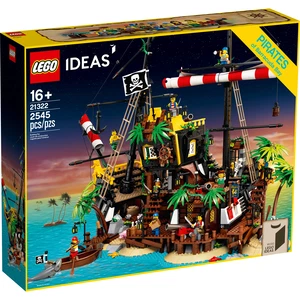
3. LEGO® Pirates of Barracuda Bay 21322
Pirates of Barracuda Bay begins as a shipwreck settlement spread across a tropical island. Broken hull sections become bedrooms, a tavern and lookout platforms, linked by docks, stairs and rope bridges. Sand, foliage and irregular timber break the model into distinct building episodes, while the crooked masts and patched sails preserve the identity of a once-imposing vessel. The result tells its story before a minifigure is moved: this is a crew that has adapted wreckage into a home.
The decisive feature is transformation. The wrecked sections can be recombined into the Black Seas Barracuda, creating a large sailing ship instead of a token secondary model. That change is not a superficial rearrangement; it gives the same 2,545-piece inventory two convincing display identities and two patterns of play. In bay form, characters explore a horizontal environment. In ship form, decks, masts, cabins and cannons produce a focused vehicle. Few adult-oriented sets commit so fully to rebuilding the finished object.
Released through Lego Ideas in 2020, set 21322 pays respect to classic Pirates without requiring prior knowledge of the 1989 ship. Its minifigure crew and graphic language supply nostalgia, but the weathered architecture and transformation stand as modern design achievements. The island can look fragmented from certain angles, and changing configurations takes space and care. Those limitations are outweighed by the generous play value and the unusual pleasure of choosing which excellent final model to keep on display.
- Pirates of Barracuda Bay
- Year: 2020
- Pieces: 2,545
4. LEGO® NASA Apollo Saturn V 21309
The Saturn V turns a difficult cylindrical subject into a disciplined sequence of radial subassemblies. Repeated shell sections are necessary, but internal connections, printed details and changes between stages keep the construction intelligible. At roughly one metre tall when assembled, the rocket has the proportions and black-and-white markings needed to be recognised immediately. Horizontal stands are included, so the finished model does not demand a tall cabinet and its three main stages can still be separated for explanation or display.
The model goes beyond an exterior tube. The command and service module, lunar module and tiny astronaut figures let the launch vehicle be taken through the broad sequence of an Apollo mission. Scale changes are handled clearly: the towering launch stack gives way to compact spacecraft and a small splashdown scene. These functions are simple rather than motorised, but they serve the subject. They invite handling and learning without compromising the clean outline that makes the rocket such a strong display piece.
Set 21309 arrived in 2017 with 1,969 pieces, a number that deliberately echoes the year of the first crewed Moon landing. Its combination of recognisable science, manageable footprint when displayed horizontally and strong price-to-experience relationship has sustained its appeal. LEGO later issued the closely related 92176 edition, but our one-lineage rule gives the ranked place to the original release. The build contains repeated curved modules, yet that repetition creates precision and rhythm instead of disguising a shortage of ideas.
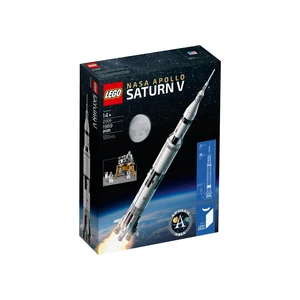
- LEGO® NASA Apollo Saturn V
- Year: 2017
- Pieces: 1,969
5. LEGO® Galaxy Explorer 10497
Galaxy Explorer reinterprets the shape and colour language of Classic Space at a much larger scale. Its broad delta profile, blue body, transparent yellow cockpit and clean white details are unmistakable, but the construction is not a simple enlargement of set 497. Angled plates and wedges create a smooth, substantial hull, while the landing gear and internal structure give the ship enough rigidity to be handled. The build feels contemporary even when its visual references are intentionally old.
A rear ramp opens to deploy the small rover, and the interior provides working room and sleeping space for the astronaut crew. Side compartments and removable surfaces make those areas accessible without dismantling the ship’s identity. Alternate instructions allow the inventory to echo other Classic Space craft, extending the creative value beyond the main model. The ship therefore succeeds as a swooshable vehicle, a shelf model and a parts-led invitation to rebuild. These three uses rarely coexist this comfortably in one adult-targeted set.
Released in 2022 with 1,254 pieces, set 10497 represents a lineage rather than merely borrowing its logos. Its score recognises both the cultural reach of Classic Space and the practical generosity of the finished model at release. Community enthusiasm also came with a useful counterpoint: affection inside a dedicated Space audience does not automatically represent every builder. We kept that limitation in view. The set ranks highly because its construction, functions and value are strong even for someone who does not bring childhood nostalgia to the box.
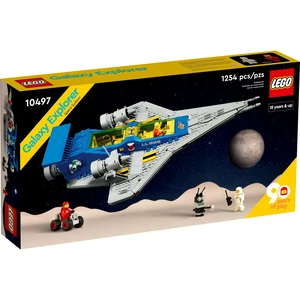
- Galaxy Explorer
- Year: 2022
- Pieces: 1,254
6. LEGO® Grand Carousel 10196
Grand Carousel is built around motion rather than using movement as a small bonus. A central drive turns the platform while a secondary mechanism raises and lowers selected animals, coordinating two actions across a broad circular model. The ring structure, canopy and decorative outer panels must remain aligned for the mechanism to run, so visual design and engineering depend on each other. That integration gives the 3,263-piece build a clear purpose from the supporting base through to the final ornament.
The completed carousel includes horses and other ride vehicles, ticket and operator details, and enough figures to make the attraction feel occupied. Its fabric canopy and warm fairground palette soften the visible Technic structure. Because the movement changes the whole silhouette, the model rewards being operated rather than admired only from one angle. It is also honest about its requirements: the circular footprint is large, the mechanical build needs careful alignment, and the sound and motion are part of the presentation rather than background features.
Released in 2009, set 10196 predates the later Fairground Collection branding but helped establish the case for large, functional attractions aimed at experienced builders. It is the oldest system-style model in this top 10 and broadens the ranking beyond recent display architecture. The original cost and specialised footprint limit its value score, while the ambitious mechanism, distinctive construction and influence on later fairground models keep it high. Official and independent records agree on the published count of 3,263 pieces.
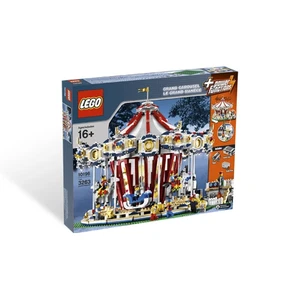
- Grand Carousel
- Year: 2009
- Pieces: 3,263
7. LEGO® Millennium Falcon™ 75192
The UCS Millennium Falcon makes its case through shape before size. Layered plates and small surface elements break up the light-grey hull, the forward mandibles converge around a detailed central section, and the offset cockpit captures the ship’s famously irregular profile. The internal frame has to support wide panels and a model that is awkward to lift, so the construction alternates dense Technic structure with modular exterior sections. It is demanding, but the sequence explains why such a broad object can hold together.
Selected interior areas recreate the lounge, engineering spaces and gunnery positions, while removable panels allow access without turning the entire hull into an open dollhouse. The radar dish can represent different film eras, and the included character selection follows the same idea. Those choices make the set more than an enormous shell, although much of its area remains structural. Display is the practical challenge: the Falcon needs a deep, strong surface, and moving the finished model is a planned operation rather than casual handling.
Released in 2017 with 7,541 pieces, set 75192 became a reference point for the scale of licensed collector sets. That cultural effect and the accuracy of the finished silhouette justify its place even though the score does not reward expense or raw piece count. Its low value input reflects a premium commitment and the space it consumes. Builders seeking constant mechanisms or free-form play have better choices above it; those who want one extraordinarily complete brick-built interpretation of a screen vehicle will understand its lasting pull.
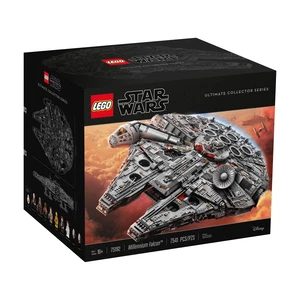
- Millennium Falcon™
- Year: 2017
- Pieces: 7,541
8. LEGO® Parisian Restaurant 10243
Parisian Restaurant demonstrates how a 32-stud-wide modular building can feel spacious without filling the baseplate with a rectangular block. The restaurant occupies the ground floor and opens onto outdoor seating, while upper levels step back into an apartment and artist’s studio. That taper creates terraces, roof lines and views that remain interesting from the street. Dark blue, olive green and tan are separated by masonry, windows and trim rather than spread as large flat colour fields.
Inside, the kitchen, dining area and living spaces use compact furniture and food details to establish distinct rooms. The staircase and layered floors follow the modular standard, so each level can be removed and the building can join a longer street. Yet the model does not depend on neighbouring sets for its composition: the side profile, chimney, awnings and rooftop details form a complete scene. The build progresses through many small architectural problems, which keeps a familiar stacked-floor format from becoming routine.
Set 10243 was released in 2014 with 2,469 pieces and became an enduring example of the Modular Buildings Collection at its most economical and detailed. It lacks a major moving function, so its innovation input sits below the mechanical models around it. In return, almost every element contributes to believable architecture or interior storytelling. Its long-term appreciation rests on proportion and craft rather than novelty. For builders who value techniques that can inform their own city designs, it remains one of the strongest classrooms LEGO has put in a box.

- Parisian Restaurant
- Year: 2014
- Pieces: 2,469
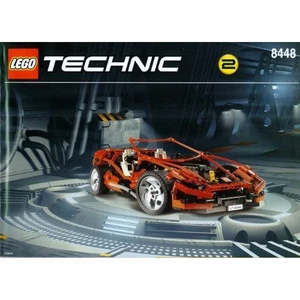
9. LEGO® Super Car 8448
Super Car represents a period when Technic flagships exposed their engineering instead of concealing it beneath dense bodywork. Steering, suspension, a multi-speed transmission and the engine are legible parts of the model, connected so that operating one system explains another. Flexible panels and beams sketch the red body without pretending to create a perfectly smooth road car. That visual openness is an advantage: the mechanisms remain the subject, and the build can be read after it is complete.
The transmission is the central attraction, but the alternate convertible-style body gives the inventory a second substantial use. Rebuilding changes more than a few panels and encourages the owner to understand how the chassis supports a different exterior. Doors and engine-cover movement add interaction without distracting from the drivetrain. By current standards, some pin-and-beam stages demand concentration and the styling is unmistakably from its era. Those qualities make it an instructive contrast with modern licensed Technic cars rather than an obsolete version of them.
LEGO’s current instruction record lists set 8448 as a 1999 release with a published count of 1,408 pieces in every checked locale. Some catalogue inventories count elements differently, so we use the consistent first-party consumer figure rather than mixing inventory totals into the table. The set earns its place for mechanical clarity, ambitious function and genuine rebuild value. It also prevents “all time” from becoming shorthand for the last decade: excellent design can remain understandable and rewarding long after construction conventions have changed.
- Super Car
- Year: 1999
- Pieces: 1,408
10. LEGO® Mighty Dinosaurs 31058
Mighty Dinosaurs is the smallest set here, and that is exactly why it matters. With 174 pieces, the main Tyrannosaurus rex still has an expressive head, articulated jaw, balanced legs, poseable tail and recognisable proportions. Ball joints make the finished animal easy to position, while the green, dark-green and tan palette creates texture without relying on printed character parts. The construction is short, but it is not disposable: each cluster of pieces has an obvious structural or anatomical job.
Creator 3-in-1 instructions rebuild the same inventory as a Triceratops or Pterodactyl. Those models are not minor accessories assembled from leftovers; each asks the builder to reconsider stance, silhouette and movement. Additional inspiration around the set has encouraged still more creatures, but the three documented forms are enough to demonstrate its flexibility. It offers play immediately, packs away easily and can be rebuilt without turning the process into a multi-day project. These are important virtues that giant adult sets do not automatically provide.
Released in 2016, set 31058 earns perfect play/display and value inputs on a very different scale from NINJAGO City. It does not claim the architectural depth, historical reach or display presence of the leaders, which keeps it at number ten. Its achievement is efficiency: a low barrier to entry, useful articulation and three convincing outcomes from a compact parts palette. Including it makes the methodology honest. If “best” is meant to cover Lego building as a whole, delight per part and the invitation to rebuild deserve a seat beside prestige models.

- Mighty Dinosaurs
- Year: 2016
- Pieces: 174
Conclusion
These 10 sets do not form a shopping list ordered by availability. Several are retired, and none was added or removed because an exact Amazon listing happened to exist. They are a scored editorial cross-section: a layered city, a modern castle, a transformable pirate settlement, space-history models, a moving fairground attraction, licensed engineering, modular architecture, visible Technic mechanics and a small rebuildable creature set. The common thread is not scale but a strong relationship between the construction process and the finished idea.
NINJAGO City wins because it combines the six factors with the fewest compromises, while Mighty Dinosaurs shows why the cutoff cannot be defined by size. Different priorities can reasonably produce a different favourite; the table makes ours inspectable rather than pretending subjectivity has disappeared. We will apply the same eligibility boundary, factor definitions and tie-break when the ranking is revisited, so a future set must earn its place against the complete candidate pool instead of displacing an older model merely because it is new.
If your next project is more important than an all-time verdict, use the ranking as a map. Choose Lion Knights’ Castle for accessible rooms and role play, Saturn V for a precise scientific display, Super Car for exposed mechanics, Parisian Restaurant for architectural technique, or Mighty Dinosaurs for compact rebuilding. Brickfact’s free app and price comparison can then help you follow the exact set you want without changing the editorial order above.