Buying your first Lego modular building is not the same decision as planning an entire brick-built town. You need one box that fits the place where you will display it, a building you actually like looking at, and a delivered price you are comfortable paying. You do not need roads, a second building or a collection plan to make that first purchase worthwhile.
Choose Tudor Corner 10350 if the timber-framed architectural style and its small specialist businesses appeal to you. Choose Shopping Street 11371 if you prefer an old-town retail scene with a central alleyway and a roof garden. Neither wins simply by having more pieces. Both belong to the Modular Buildings Collection and both are marked for adults aged 18 and over.
These two boxes are shortlisted as complete adult display scenes: each includes a furnished building and minifigures, with no second set needed. Their similar footprint and spending category make architecture and interiors the useful deciding factors. Retired collector models and larger licensed buildings answer different buying questions; explore the wider collection if neither subject appeals to you.
The two first-purchase options at a glance
| Set | Pieces | Published H × W × D (cm) | Choose for |
|---|---|---|---|
| Tudor Corner (10350) | 3,266 | 31 × 26 × 25 | Tudor architecture and specialist interiors |
| Shopping Street (11371) | 3,456 | 36 × 25 × 25 | Retail scene, alleyway and roof garden |
Use the product cards to compare current offers for your country. UK and US prices, taxes, stock and delivery dates differ; a dollar price does not establish what a UK buyer should pay. Compare the total for the same set number locally. The published dimensions are “over” the stated measurements, so allow clearance rather than buying a cabinet that merely matches them.
Tudor Corner 10350: choose architecture and intimate interiors
Tudor Corner combines an unmistakable timber-framed appearance with a restaurant, a haberdashery, a clockmaker’s workshop and an attic apartment. Its 3,266 pieces create a building whose appeal is spread across different kinds of spaces, rather than concentrated in one large shop. Eight minifigures, including a chef and a chimney sweep, give those rooms occupants without requiring another purchase.
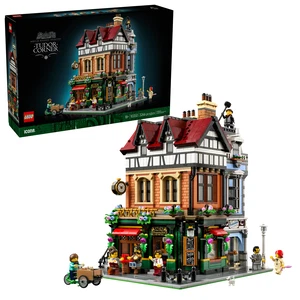
This is the stronger match if you like historical-looking buildings and small occupational details. The restaurant and haberdashery supply everyday street-level activity; the clockmaker’s workshop gives you a more specialized subject to explore. The attic apartment adds a domestic layer above the businesses. Those are distinct reasons to choose the box, not evidence that it is the easiest modular or the best investment.
Think about what you will see after the build. If it stays on a shelf and you mostly view the outside, the architectural treatment matters more than the number of rooms. If you like returning to a finished model to inspect its interiors, the variety of businesses becomes more important. Buying because of an interior you intend to explore is different from buying because of a facade you want in your room.
The model measures over 31 cm high, 26 cm wide and 25 cm deep. That footprint still needs a substantial shelf. Its lower published height compared with Shopping Street is useful when overhead clearance is your limiting factor, but neither model should be ordered for a cabinet whose internal height merely equals the stated figure.
We built and tested Tudor Corner 10350 ourselves. Our Brickfact advice is to choose its architecture and room themes, rather than assume that a favourite-looking building will also be the easiest first build.
Shopping Street 11371: choose a complete retail scene
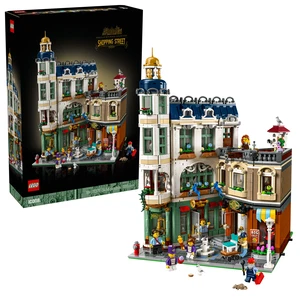
Shopping Street offers a music shop with marching-band instruments, a furniture store and a furnished apartment. A roof garden and central alleyway give the scene points of interest beyond the shopfronts. The box contains 3,456 pieces and seven minifigures. It is a good first purchase when you want the feeling of a small shopping street in one model, rather than a single architectural style taking centre stage.
- Pieces: 3,456
- Age: 18 and up
- Central alleyway and roof garden
The music shop is the specific reason to favour it if instruments and retail displays interest you. The furniture store complements that with a different kind of merchandise; the apartment supplies the lived-in space above. The alleyway also changes the visual composition: look at the whole street scene, not just the main elevation, when deciding whether you prefer it to Tudor Corner.
Choose this model because you enjoy those subjects, not because its higher piece count automatically means more useful building time. Pieces can serve different structural and decorative purposes. A count cannot tell you whether you will enjoy a roof garden more than a clockmaker’s workshop, or whether you prefer the finished silhouette.
Shopping Street measures over 36 cm high, 25 cm wide and 25 cm deep. Its published width is slightly narrower, but that does not make it a compact alternative in practical shelf planning. Both options occupy roughly the same class of display space, while Shopping Street needs more height. Measure first if it will sit beneath another shelf.
If you expect to expand later, picture the building in your planned street as well as on its own. Tudor Corner’s corner architecture and three facades deserve a viewing position that shows their shape; Shopping Street’s alleyway and plaza make the relationship between its shops part of the scene. Keep room beside the model before buying another modular. Neither choice obliges you to add roads, and a complete furnished scene remains useful even if the collection stops at one box.
Measure the display space, not just your building table
Start with the permanent display location. Measure usable width, depth and height inside the shelf, accounting for supports, doors and the space needed to put the model in place. A nominally deep shelf can have a shallower usable area if its back panel or front lip intrudes. Leave room to lift and handle the finished build rather than pressing it against every surface.
Then consider the view. A high shelf may show the street facade clearly while hiding details near the roof; an enclosed cabinet may make side views awkward. This does not change the contents of either box, but it changes which features you will enjoy regularly. A favourite model in a poorly chosen location can be less satisfying than a different building displayed properly.
If you later add lighting, check how its cables run between floors before fitting it. Taut wiring can make opening the interiors awkward. An arrangement that preserves access matters if you enjoy revisiting the rooms; treat lighting as a separate, optional project.
Set an acquisition ceiling before comparing offers
Choose a maximum total acquisition price, including delivery and any applicable tax, before opening the offer list. Compare offers in your country; a lower headline price can disappear once shipping is added. A backorder can also be a poor fit for a date-sensitive gift even when the price is acceptable.
Compare the exact set numbers: 10350 and 11371. A used assembled model, a sealed complete set and a listing for instructions alone are not equivalent offers. If buying used, ask about completeness, minifigures, instructions and the condition of important decorative elements. Include the effort of checking a large building in your decision, not only the cash saving.
Do not make an older retired building your default starting point just because a previous guide praised it. Jazz Club 10312 is not a current first-choice recommendation here. Remaining stock or a used copy can make sense for someone who specifically wants that building, but it should be a deliberate character-and-condition choice rather than an assumption of ordinary current supply.
If both delivered offers fit your ceiling, a modest saving should be weighed against which building you actually want to keep on display. If only one fits, check its dispatch date before treating it as the winner. If neither fits, the wider catalogue is a better next step than stretching the budget for this shortlist.
One building is enough to start
If your answer is “I want Tudor architecture,” buy Tudor Corner when the total and delivery timing work for you. If it is “I want the music shop, alleyway and roof garden,” choose Shopping Street. If neither subject feels right, waiting is more sensible than buying whichever has the smallest price-per-piece figure.
Use the Modular Buildings Collection catalogue to compare the wider collection and its offers. Once you want streets, roads and a larger layout, the city-planning guide takes over that different decision. This guide stops at selecting one box: it does not require you to buy the rest of a town.