A budget below €100 opens the door to larger Lego display models, mechanical builds and sets with stronger shelf presence. It also raises the amount at risk in every box. Larger products use more storage space, cost more to ship and can take longer to sell. A convincing investment candidate in this tier therefore needs more than a high piece count or a familiar logo.
Our selection applies the ceiling to European recommended retail price and does not repeat products from the 2026 guide below €30 or the 2026 guide below €50. As of 3 September 2026, current retirement forecasts place all five sets below in December 2026. Lego can revise schedules, and shops can hold stock after production ends, so the forecast should never be treated as an official promise of scarcity.
There is no guarantee of a profit. Purchase price, condition, future competition, fees, storage and the eventual buyer pool determine the outcome. The ranking explains both the collector case and the reasons each set could disappoint.
How we ranked the under-€100 sets
We looked for products that make good use of the higher budget: a complete display concept, a distinctive subject, meaningful characters or an identity that is difficult to replace with a generic build. We compared audience breadth, licence strength, shelf presentation, supply risk, likely reissue pressure and practical handling costs. A large set scores poorly if a near-identical successor can easily satisfy the same buyer.
The result covers Star Wars, Formula 1 history, a mechanical astronomy model, a design icon and a science-history display. It is intentionally not a list of five similar helmets or vehicles. The selection reaches franchise collectors, motorsport fans, education-minded builders and buyers of adult display objects, limiting the damage if one theme receives an immediate remake.
| Rank | Set | RRP | Pieces | Main collector argument |
|---|---|---|---|---|
| 1 | 75328 The Mandalorian Helmet | €69.99 | 584 | Recognisable beskar display in the helmet series |
| 2 | 10353 Williams Racing FW14B & Nigel Mansell | €79.99 | 799 | The 1992 championship car with its named driver |
| 3 | 42179 Planet Earth and Moon in Orbit | €79.99 | 526 | A geared, educational model with visible orbital motion |
| 4 | 21345 Polaroid OneStep SX-70 Camera | €79.99 | 516 | Licensed design object with a working photo mechanism |
| 5 | 21355 The Evolution of STEM | €79.99 | 879 | Three historical figures and interactive science displays |
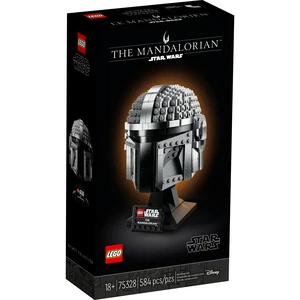
1. Lego® Star Wars 75328 The Mandalorian™ Helmet
- RRP: €69.99
- Pieces: 584
- Brick-built stand and nameplate
- Lacquered elements recreate the beskar sheen
The Mandalorian Helmet uses 584 pieces and sits on a brick-built black stand with a nameplate. Lacquered elements recreate the changing sheen of beskar, while the central visor gives the model a strong silhouette from across a room. It belongs to the established Star Wars helmet line and is designed primarily for display.
Why it takes first place
Din Djarin's helmet is the visual signature of a modern Star Wars lead character. It can interest viewers of The Mandalorian, helmet-series collectors and buyers who want one recognisable franchise object without building a large ship. The standardised stand makes it compatible with other helmets, so later additions to the line may keep collectors interested in this earlier model.
The design is also more specific than a generic silver helmet. The beskar surface and T-shaped visor communicate the character immediately, while the €69.99 RRP remains below many adult Star Wars display sets. That combination of subject recognition and series continuity gives it the top rank.
A large fan base brings large supply
Star Wars display products can be manufactured and stocked widely. The helmet has had time to reach many collectors, and sealed copies may remain available after production stops. Din Djarin is unlikely to disappear from Lego's portfolio forever; a revised helmet, bust or other display could compete with it. The lacquered look can also be improved in a later interpretation.
A discount and excellent box condition are essential. Do not pay a retirement premium because one shop runs out. The rectangular box stores efficiently, but its broad printed face should be protected from scratches, fading and pressure.
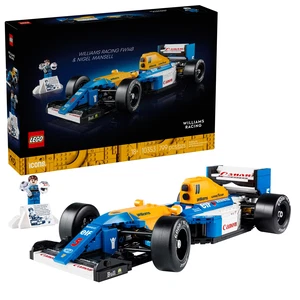
2. Lego® Icons 10353 Williams Racing FW14B & Nigel Mansell
- RRP: €79.99
- Pieces: 799
- Working steering and detailed engine
- Stands for car and Nigel Mansell minifigure
This 799-piece Lego Icons set recreates the Williams Racing FW14B driven by Nigel Mansell to the 1992 Formula 1 championship. The car combines working steering with a detailed engine, and the completed model sits on its own display stand. A named Nigel Mansell minifigure has a separate stand, making the set a tribute to both machine and driver.
A specific car from a defining season
The FW14B has a precise identity: team, driver, year and championship story are all contained in one box. That gives collectors several points of connection, from Williams and Mansell fandom to interest in 1990s Formula 1 engineering. The separate stand keeps the named driver visible when the car joins other racing models.
At €79.99, the model offers more mechanical and historical detail than a small racing replica without the demands of the largest vehicle sets. Working steering and the engine reward builders, while the two stands organise the finished display. It ranks second because it reaches Lego vehicle collectors and established motorsport audiences.
Supply, successors and presentation risk
Formula 1 is receiving substantial attention across Lego ranges, supporting interest but also creating alternatives. Broad production could leave sealed stock available well after retirement, while a future classic Formula 1 or Williams car may compete for the same shelf space.
The livery relies on numerous graphic details, so decals and licensing are part of the long-term risk. Applied stickers matter to built copies, while sealed collectors still have to consider whether future licensed interpretations will present the same era more convincingly. Buy below RRP where possible and protect the box from pressure; the strongest case rests on the exact FW14B and Mansell pairing, not on an assumption that every Formula 1 set will become scarce.
3. Lego® Technic 42179 Planet Earth and Moon in Orbit

- RRP: €79.99
- Pieces: 526
- Crank-driven orbital movement
- Printed months and Moon phases
Planet Earth and Moon in Orbit uses 526 Technic pieces to demonstrate the relationship between the Sun, Earth and Moon. Turning the crank drives the gearing, rotating the Earth and moving the Moon through its orbit. Printed months and Moon phases connect the motion to a calendar, so the mechanism communicates more than an abstract gear train.
Education and display in the same mechanism
The set belongs on a desk, in a study area or in a classroom. Its moving parts invite demonstration, while the labelled cycle encourages builders to observe how the positions change. Unlike a static globe or a conventional Technic vehicle, the gears are central to the model's educational character.
It reaches an audience different from the licensed entries around it. Astronomy enthusiasts, science-minded families and Technic builders can understand the purpose without knowing a fictional universe or sporting season. The model ranks third for its coherent mechanical identity, although the lack of an exclusive character or licence may reduce urgency among sealed-box collectors.
A useful model is not automatically a scarce one
The subject is generic and nonlicensed, allowing Lego or another educational range to revisit the same orbital lesson in a more compact or more detailed form. Buyers interested mainly in the mechanism may prefer a complete used build, especially when they want it for demonstration rather than sealed collecting. That can narrow the premium for an unopened copy.
The extended arms and visible gearing also make the finished model relatively bulky, while the box must protect many functional components. Future educational models could offer smoother movement, additional planets or a smaller footprint. A sensible entry price leaves room for those risks; the investment case is strongest when the set's distinctive crank-driven presentation is valued as much as its subject.
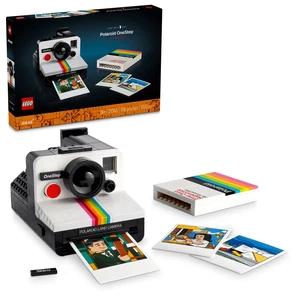
4. Lego® Ideas 21345 Polaroid OneStep SX-70 Camera
- RRP: €79.99
- Pieces: 516
- Working photo-eject mechanism
- Three illustrated photos and film pack
The 516-piece model reproduces a Polaroid OneStep SX-70 camera at close to real-world scale. It includes a film pack and three illustrated photos. Loading one of the photos and pressing the shutter activates a mechanism that ejects the picture, giving the display object a simple but memorable function.
A design object rather than a conventional toy
The camera can attract photography enthusiasts, retro-design fans and adults who may not collect a particular Lego theme. The white body, rainbow stripe and instant-photo format are easy to recognise. As an Ideas set, it also represents a fan-originated concept with a clearly defined subject rather than a generic camera build.
The working mechanism gives a demonstrable feature that can remain interesting in a sealed product description after retirement. It helps distinguish the model from purely static décor and makes the box suitable as a gift for photographers.
Limited audience and replacement pressure
A camera is a narrower collectible than a Star Wars helmet or championship racing car. Some buyers may prefer to purchase and build it now rather than pay more later. Lego also continues to explore household and technology objects, so another camera could offer greater detail or a different iconic brand. The model's light-coloured box and white pieces should be protected from sunlight and moisture.
At €79.99 for 516 pieces, the product relies on design and licensing rather than raw part value. That is not a flaw, but it means the entry price must reflect the specific audience. A solid discount is more compelling than betting on the Polaroid name alone.
5. Lego® Ideas 21355 The Evolution of STEM
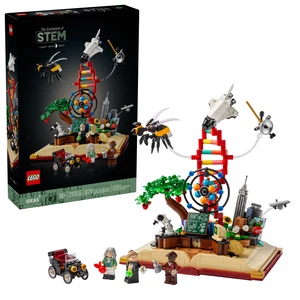
The Evolution of STEM uses 879 pieces to combine several scientific milestones in one display. Marie Curie, Isaac Newton and George Washington Carver are represented as minifigures. A moving atom, a rotating DNA strand and other small scenes create an interactive timeline rather than one large model.
Educational identity and rare figures
Science history is unusual territory for a retail Lego set. The three historical figures give the box relevance to educators, science enthusiasts and minifigure collectors. The modular timeline can be discussed and displayed in a classroom or office, while the moving elements keep the presentation from feeling static.
Its position in fifth place is not a judgement on the subject. It reflects uncertainty about the size of the resale audience. The set covers several disciplines, but no single build is as instantly recognisable as the Mandalorian helmet or Polaroid camera. Buyers may admire the idea without feeling the need to own a sealed copy.
A distinctive set can still be difficult to sell
Historical minifigures may be desirable separately, which can encourage opened boxes and parting out instead of sealed collecting. Educational institutions usually buy on a budget, and future science-themed products can offer a more focused display. The broad box also needs careful storage.
Buy only when the price leaves room for a patient sale. As a single copy, the set adds a genuinely different audience to a portfolio. As a large holding, it would depend too heavily on a specialised concept whose long-term demand is hard to estimate.
Purchase price, storage and exit planning
For larger boxes, calculate the complete cost before buying. Delivery, protective packaging, storage shelves, marketplace fees and insured shipping can materially change the break-even point. Record those amounts alongside the purchase date and box condition. A percentage increase in an online price guide is not the same as money received after a sale.
Inspect factory seals and every large panel when the order arrives. Keep boxes dry, dark and upright or evenly supported. Avoid placing concentrated weight on the centre of a wide package. If storage space is limited, a smaller set with a slightly weaker collector case may be more practical than a bulky product that becomes damaged.
Plan for different exit routes. Display collectors may value pristine packaging, while builders may compare your sealed price with complete used copies. Patiently listing one set can work; needing to sell ten identical boxes at once can force a discount. The lower-budget guides for sets below €30 and sets below €50 offer more compact ways to diversify.
Conclusion: the best under-€100 choices retiring in 2026
The Mandalorian Helmet leads because it combines a recognisable modern Star Wars character with an established collector format. The Williams Racing FW14B follows with a specific championship car, a named Nigel Mansell figure and functional detail. Planet Earth and Moon in Orbit adds a distinctive geared science display, while the Polaroid camera and Evolution of STEM reach adult audiences beyond conventional vehicle and franchise collecting.
Every candidate has a clear counterargument: supply, a future remake, storage cost or a narrower audience. Treat the December 2026 schedule as a forecast, not a deadline. The strongest decision is usually a clean box bought below RRP with enough patience and diversification to withstand a slow market.
Frequently asked questions
Why use RRP for the €100 threshold?
RRP makes the tiers stable and comparable across retailers. A short discount can bring a more expensive set below €100, but its box size, normal buyer expectations and capital requirement still belong to a higher bracket.
Are bigger sets more profitable than small sets?
Not automatically. They can produce a larger absolute gain, but they also use more capital, storage and shipping materials. Demand and entry price matter more than dimensions alone.
Does a Lego Ideas label make a set rare?
No. Ideas sets can be distinctive, but production volumes and retail lifetimes vary. The label supports a product story; it does not guarantee limited supply.
Should I wait until the set is sold out everywhere?
Waiting can confirm scarcity, but it can also remove discounts and create urgency-driven prices. A disciplined purchase while several retailers still compete is often preferable to chasing the final box.
How should the five sets be combined?
Choose according to space and the audiences you understand. A helmet, a historic racing model and one non-entertainment display provide more varied exposure than several copies of a single licence, but no combination removes the possibility of loss.