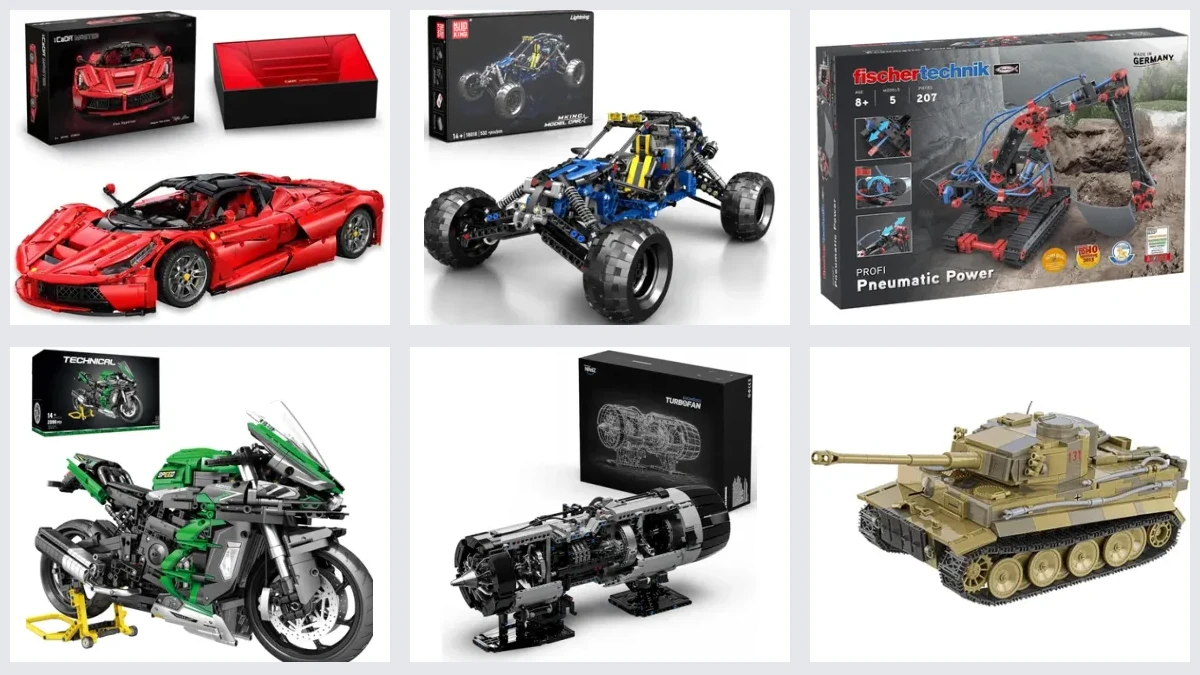
fischertechnik and Lego Technic are built around the same satisfying idea: a model should explain itself through movement. Both can demonstrate gears, linkages and steering, yet their parts and priorities are different. fischertechnik favours visible experiments that can be rebuilt repeatedly. Lego Technic usually wraps a mechanism inside a recognizable vehicle or machine.
The important question is therefore not which brand wins overall, but what you want to do after opening the box. Choose fischertechnik to investigate a principle and rearrange a compact laboratory. Choose Technic when constructing one detailed model is the main event and the mechanism supports that subject.
| Decision | fischertechnik | Lego Technic |
|---|---|---|
| Main strength | Exposed experiments and rebuilding | Detailed vehicles with integrated functions |
| Construction | Proprietary slide-and-lock system | Pins, axles, beams and connectors |
| Pneumatics | Dedicated learning kits | Appears in selected, usually larger sets |
| Finished result | Functional teaching model | Play or display model |
| Existing collection | Best as its own system | Extends a Technic parts collection |
How the building systems differ
fischertechnik blocks connect through the brand's own groove-and-tab principle and can accept additions on several faces. This makes it quick to move a valve, change a linkage or build another model from the same box. It is its own ecosystem: buy it for the complete learning system, not as an expansion pack for Lego Technic pieces.
Technic uses liftarms, pins, axles and gears. Those parts reward careful alignment and let mechanisms sit inside shaped bodywork. A vehicle can therefore look finished while still offering steering, moving pistons or a working shovel. Motors, hubs and apps need separate attention: mechanical resemblance never guarantees electrical compatibility between systems.
Pneumatics and visible learning
Pneumatics are where the contrast is clearest. A fischertechnik learning model keeps the pump, air reservoir, hoses, valves and cylinders easy to follow. Turning a valve visibly changes the air path. That makes troubleshooting part of the lesson rather than an interruption.
Lego Technic pneumatic sets can offer a richer vehicle around the same broad physical principle, but pneumatics are not included in every Technic box. If the goal is specifically to compare cylinders and rebuild several small machines, check the box contents instead of buying on the Technic logo alone.
For a gift, ask whether the recipient wants to keep a completed model or dismantle it for the next experiment. Decide that before choosing accessories.
Two focused starter choices
These are two different entry routes, not a pneumatic head-to-head test. Pneumatic Power starts with air pressure and five successive experiments; the manual Volvo loader starts with vehicle building, steering and a working shovel. The loader is not a substitute for a kit of pneumatic cylinders. Choose the activity first, then compare the cost of the complete box.
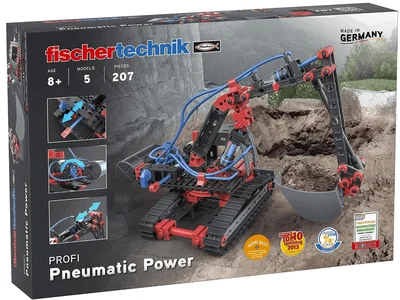
fischertechnik Pneumatic Power 533874
- 207 parts and a recommended age of 8+
- Five models can be built one after another
- Hand pump, air reservoir, two cylinders and two hand valves
Pneumatic Power is the clearer choice for a child, family or classroom that wants to see compressed air at work. The pump is manual; there is no included electric compressor to charge or configure. Because the same components become five machines, the learning value comes from dismantling and rebuilding, not from leaving one polished model on a shelf.
We have built and tested Pneumatic Power ourselves. We would choose it for tracing the air path again between builds, rather than judging it by how closely it resembles a finished vehicle.
See the Pneumatic Power buying example in our Technic alternatives guide.
Lego Technic 42209 Volvo L120 Electric Wheel Loader
- 973 pieces and a recommended age of 9+
- Articulated steering and a shovel that raises, lowers and tilts
- Three gears rotate visibly under the engine cover
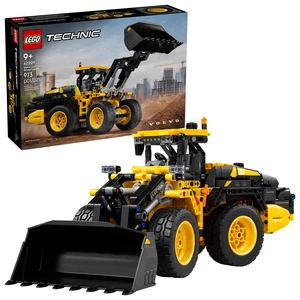
- Pieces: 973
- Age: 9 and up
- Manual steering and shovel functions
The word “Electric” belongs to the real Volvo machine represented by the set. This Lego model is manual and not motorized; its charging socket is a play detail. It is the stronger choice when the recipient wants to build a recognizable construction vehicle and operate linked controls afterward.
Compare the full starting cost
For either example, start with the delivered price of the complete set: no motor, battery or app is required for the functions described here. Pneumatic Power already includes its manual air supply and controls. For a classroom, decide how many builders will share one kit; its five models use the same parts rather than providing five simultaneous stations. For a pneumatic Technic project, price a set that actually contains cylinders instead of adding unplanned accessories to this loader.
Which one should you buy?
Choose fischertechnik for experiments, pneumatics and frequent redesign. It asks “what happens if this connection changes?” and makes the answer easy to observe. Choose Lego Technic for a longer vehicle build, a more sculpted result and parts that continue an existing Technic collection.
For a household starting from zero, Pneumatic Power is the more direct lesson in air pressure. For a Lego fan who already understands pins and axles, the Volvo loader offers a familiar system with several manual functions. Neither choice needs a motor, batteries or an app.
Our broader Lego Technic alternatives guide compares more brands. This page deliberately stays with the fischertechnik–Technic decision.